Modern risk exposures are evolving rapidly. Yet, according to Gartner, only 18% of enterprise risk management (ERM) leaders feel confident in identifying and managing emerging risks. The amount of risk and relative lack of preparedness only underscores the need to create a clearer picture of the risks you face using an enterprise risk management framework.
Regardless of size or industry, every organization approaches ERM from a different starting point. Some may be building foundational risk practices, while others are working to integrate risk management into strategic decision-making. This variation in ERM maturity is key. Early-stage organizations might focus on establishing risk governance and basic processes, while more mature entities may prioritize embedding ERM across business units and aligning it closely with performance goals.
But an ERM framework doesn’t exist in a vacuum. Instead, it’s a guide for how to put your ERM strategy into action. But what exactly is an ERM strategy, and how does that influence your framework? With many enterprise risk management frameworks available, knowing which to choose can be a challenge even after you’ve created a strategy. How do you determine the best ERM framework? And once you’ve made your assessment, how do you implement your chosen framework?
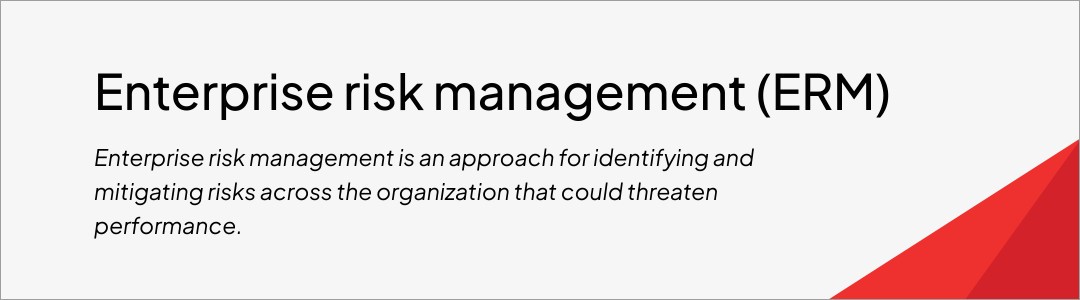
ERM is proactive and forward-looking rather than reviewing risks that have already happened, as traditional risk management tends to do. Unlike traditional risk management, ERM looks at the “opportunity” certain risks present rather than focusing on total risk avoidance. This makes ERM a strategic tool for boards rather than the reactive process that traditional risk management can be.
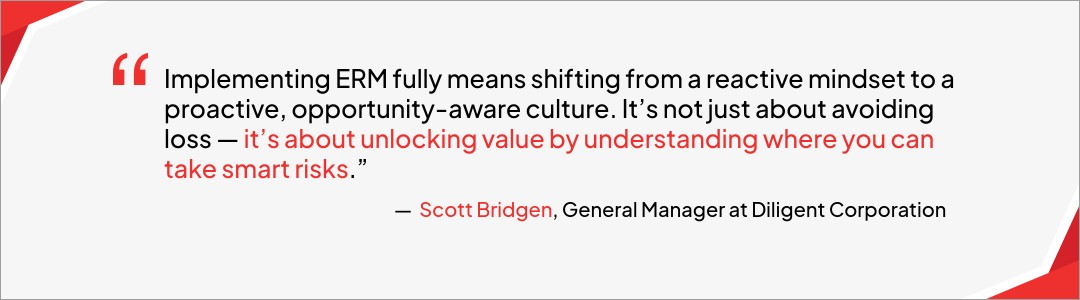
“ERM views risks through the lens of both protecting and creating value. The best ERM leaders take seriously not only identifying which risks to avoid but also those worth taking.” — Scott Bridgen, General Manager at Diligent Corporation
Consider this: A U.S. financial services company recently wrapped up its eighth acquisition and needed to reduce its risk. Lack of visibility across the enterprise introduced unnecessary risk and prevented the board from getting a real-time view of performance. In this case, ERM looked like implementing a single solution across ERM, compliance, policy management, internal audit and SOX. Using a single solution facilitated an integrated view of risk across the entire organization, making it easier for the board to take a risk-aware approach to growth.
You can read more about ERM's meaning and how it differs from integrated risk management in our article on ERM vs. IRM.
Organizations face countless different types of risk: financial, cyber, environmental and more. However, some types of enterprise risk are more common than others. Most enterprise risk management strategies should account for the following risk types:
The primary goal of enterprise risk management is to identify, assess, manage, and monitor risks across the organization. Doing so doesn’t just avoid harm but helps leaders make better, more confident decisions.
In simpler terms, effective ERM helps organizations:
When ERM is done well, risk becomes less of a threat and more of a strategic advantage.
ERM is important because it is a strategic asset. According to PwC, 62% of organizations seek to uncover opportunities within risks. Moreover, the risk pioneers, as PwC calls it — organizations viewing risk as value creation — were more than two times more likely to have improved financial performance due to effective risk mitigation.
In this light, the right ERM strategy can make risk something to embrace. The more risks you can identify, the more you can either mitigate or become a value add for the entire organization.
ERM also helps organizations:
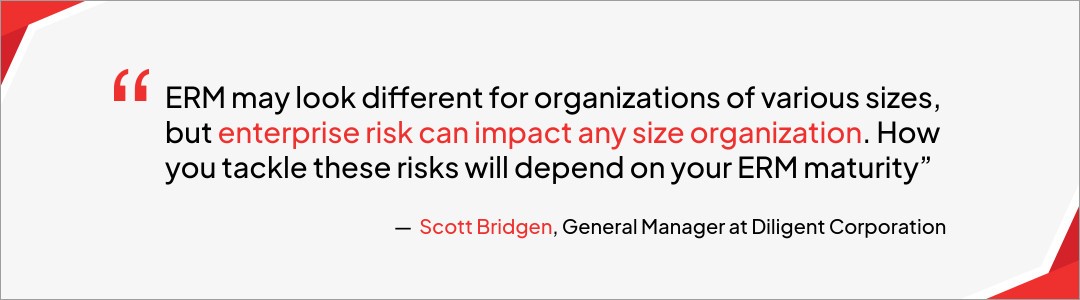
A common misconception is that enterprise risk management is only relevant for large corporations with complex operations and dedicated risk teams. But in reality, ERM principles are valuable for organizations of all sizes and sectors.
ERM isn’t about adding bureaucracy — it’s about making smarter, more informed decisions. Whether you're a multinational enterprise managing global risks or a growing company navigating market uncertainty, the core idea remains the same: understanding the risks that could impact your objectives, and having a structured approach to managing them.
Smaller organizations, in particular, can benefit from adopting ERM early. Building a risk-aware culture and establishing clear accountability from the outset can help avoid costly surprises down the line. And because ERM is scalable, you don’t need to implement a full-blown framework overnight. Even simple practices — like consistent risk assessments, scenario planning, or defining roles and responsibilities — can deliver meaningful value and lay the groundwork for more mature risk practices in the future.
ERM is not just for risk professionals — it’s for leaders at every level who want to build resilience, protect value, and support better decision-making across the organization.
Enterprise risk management is a methodology, but it’s also a strategy that governs an organization’s view of and response to enterprise risks. At the same time, ERM safeguards the broader corporate strategy and objectives; ERM addresses any risks that may threaten it.
But how exactly does ERM advance risk management from being reactionary to strategic? With the right framework, ERM:
In that way, modern organizations can’t achieve their strategic objectives without an equally strategic approach to ERM. Boards should treat ERM like a meteorologist, forecasting the winds that would either help or hinder the organization as it advances to new frontiers.
An enterprise risk management strategy has several different pieces, all working together to inform how the organization approaches enterprise risk. As you develop your own ERM strategy, consider:
Get the seven best practices to transform your ERM program from underperforming to best-in-class.

Your enterprise risk management policy is your rules of the road. It sets formal expectations, principles and rules for how your organization manages risk, all rooted in your overarching ERM strategy. Following an ERM policy makes it easier for everyone at all levels to follow a consistent risk approach.
While the contents of your policy will likely be unique, a typical enterprise risk management policy template includes:
An enterprise risk management framework puts rigor around your ERM strategy, helping you execute performance-enhancing ERM. It provides structure, consistency and the assurance that you have covered all the necessary issues.
An ERM Framework can help leadership understand, prioritize and act on key risks. It can also help those on the ground implement risk-management programs in accordance with regulatory, organizational and best-practice guidelines. Thus, it can help drive a consistent risk-management culture, minimizing the chance of risks “slipping through the cracks.”
Watch this episode of Inside America's Boardrooms as Catherine Hall, Director of PwC's Governance Insights Center, frames the ERM landscape and offers guidance for boards navigating this ever-evolving space.
What are the components of an ERM framework? There are a few steps to building an enterprise risk management framework.
1. Set up a senior-level steering committee
It’s vital to have senior leadership on board to drive the development of your ERM framework forward. Your committee will play a key role in determining accountabilities and roles within the framework, signaling the project's importance to the rest of the workforce.
2. Ensure everyone has a shared understanding of risk
As with all big topics, understanding and terminology around risk can vary widely within a business. Establishing standard terms and a consistent frame of reference is an essential early step.
3. Set out roles and responsibilities
Who will take responsibility for what in your enterprise risk management strategy? There are roles not just for your board and senior leaders. Management, business unit leaders and people throughout each function all have a part to play, and you must clearly define their roles.
ERM is far from being the preserve only of your compliance, risk and internal audit teams — but their expertise will mean they have central roles in the process.
4. Identify your risks
Your business units must work with your risk management team to build a comprehensive list of organizational risks. Review your risks, including their severity and likelihood, the internal controls that manage them and your approach to mitigating them.
5. Document your risks and risk appetite
Once you’ve identified the organization’s risks, ensure every business area captures them in a formal statement. And ensure that this documents not just your risks but also your approach to dealing with them. Which risks should you avoid at all costs, and which risks can you tolerate? Are there risks you should actively take, as the potential opportunity outweighs the threat?
6. Prioritize all your risks
Prioritize the risks you face and implement mitigation plans for those you cannot avoid.
7. Establish an ERM methodology
This means putting in place consistent and agreed-upon definitions of key terms (does everyone understand the same thing by the word “risk,” for example?), roles, and processes to identify, review, measure and report the risks you face.
Many established ERM frameworks exist (and we look at these in more detail below). Explore whether you can draw on, adopt or adapt an existing framework.
8. Monitor and report on the risks you face
ERM — and implementing an ERM framework — isn’t a “once and done” exercise. It involves continuously monitoring the risks you face; these will change regularly in today’s volatile world. Therefore, your ERM framework needs to be agile, adaptable and reviewed periodically to ensure it still aligns with your business's threats.
Organizations need to weigh the positives of using a tried-and-tested framework against the potential benefits of developing a customized ERM framework. For organizations considering launching an ERM program, there’s no one-size-fits-all answer, what works best depends on your organization’s objectives, risk culture and current level of maturity.
Using a tried-and-tested ERM framework offers a strong starting point, especially for organizations new to enterprise risk management. These models are built on best practices, refined over time, and provide structure, common language and guidance that can help streamline implementation.
At the same time, some organizations may find that tailoring a framework to their specific needs offers greater flexibility and better alignment with internal processes. A customized approach allows you to scale ERM in a way that reflects your size, industry, and culture, which is an advantage if existing frameworks feel too rigid or overly complex for your context.
Ultimately, you don’t have to choose one or the other. Many organizations start with a recognized framework and gradually adapt it over time.
So, what is the best enterprise risk management framework? The answer is it depends on your organization’s needs, but here are several commonly used ERM frameworks:
Along with the Society of Actuaries (SOA) and the Canadian Institute of Actuaries (CIA), the Casualty Actuarial Society (CAS) sponsors a risk management website. The site includes resources companies can access on ERM, including an ERM framework.
The Committee of Sponsoring Organisations of the Treadway Commission (COSO) ERM framework is titled Enterprise Risk Management—Integrating with Strategy and Performance. The COSO enterprise risk management framework incorporates guidelines from the Sarbanes-Oxley Act (SOX), and as such, the purpose of the COSO enterprise risk management framework is aligned closely with the needs of businesses that need to comply with SOX; financial institutions, banks and other large corporations in the scope of SOX regulation.
The ISO 31000:2018 Risk Management framework is an international standard built by the International Organization for Standardization (ISO). It is a cyclical framework that delivers risk management guidelines and principles.
ISO reviews the framework every five years to keep pace with changes in the risk landscape. The organization can customize it, making it relevant across sectors and organization sizes.
The National Institute of Standards and Technology (NIST) framework focuses on cybersecurity, aimed at organizations doing business with U.S. government agencies.
The COBIT ERM framework was designed by the Information Systems Audit and Control Association (ISACA) to connect the dots between technical and strategic risks. It recognizes that technology risks now pervade all areas of organizations and are not confined to the IT department.
The Risk Management Society’s RIMS Risk Maturity Model® provides standardized criteria by which organizations can benchmark risk management strategies, assess the maturity of their risk mitigation programs and identify strengths, weaknesses and next steps.
This model integrates governance, risk and compliance (GRC) into one streamlined approach. It emphasizes doing the right thing while achieving business goals, making it a sound risk approach for organizations that prioritize ethics and compliance.
The Basel Frameworks II and III are best for enterprise risk management in banks and financial institutions. They focus specifically on credit risk, operational risk and market risk. The framework also guides navigating regulatory oversight.
CIOs and digital transformation leaders may favor COBIT, an ERM model focusing on risk management with IT governance and technology lean. It offers tools for aligning IT with business goals while managing the associated risks.
Your ERM plan is the blueprint that brings your framework of choice to life. It translates ERM strategy, policy and risk appetite into clear, practical steps your organization will take to identify, assess, manage and monitor risks.
Here’s a typical structure:
Your enterprise risk management process is integral to your ERM plan. This process takes you from identifying a risk to mitigating it. In essence, there is no ERM without a documented risk management plan.
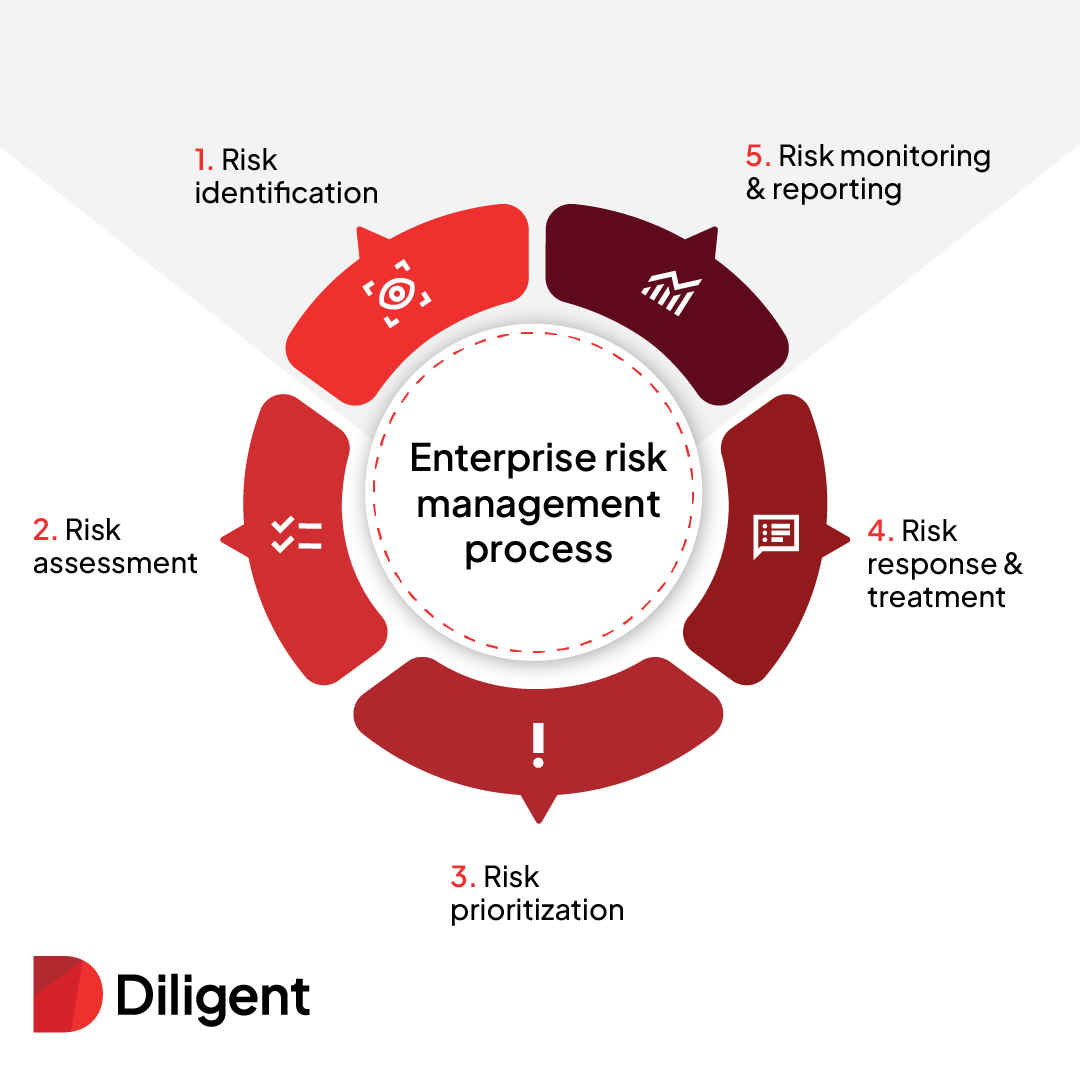
Most risk management follows a five-step ERM process:
The larger the organization, the more essential — and the more difficult — it is to follow a clear process. Duopharma Biotech Barhard, for example, maintained a complex ERM process, involving a spreadsheet with more than 2,000 risks registered and 250 risk owners across multiple global jurisdictions. It needed a solution to process data faster, reduce errors and streamline reporting to maintain this process.
The company adopted Diligent Enterprise Risk Management, expediting its ERM process. Instead of a week, it could generate reports in just three days, allowing risk teams to spend less time identifying risks and more time analyzing and prioritizing them.
“We’re now doing more analysis, which leads to more excitement and education for my team, but most importantly, more strategy for the organization,” says Anita Esa, Head of Group Risk Management at Duopharma Biotech Berhard.
Whether your ERM process succeeds or fails is largely due to your risk assessments. A solid ERM risk assessment should identify and prioritize risks impacting your goals so you can respond effectively.
To conduct one:
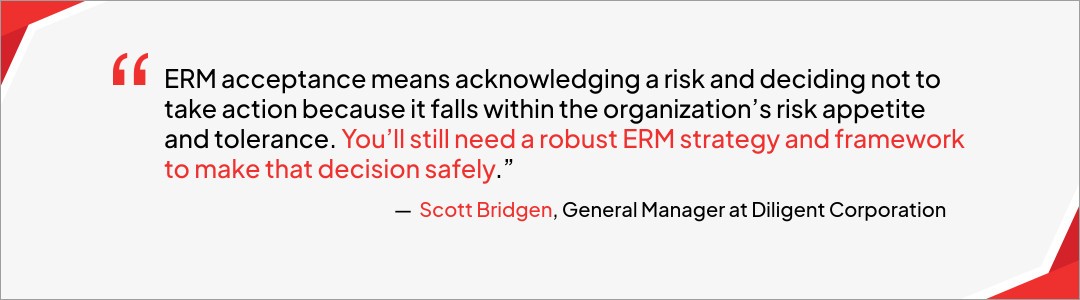
Imagine you have to upgrade a technology system, which will require downtime. That downtime is a risk — you could upset or even lose users. However, scheduling it during a low-usage period within user tolerance will reduce the risk. In this scenario, your best option is often ERM acceptance — identifying and understanding a risk and accepting it for now.
While your ERM risk assessment will undoubtedly yield risks worth acting on, there will always be risks you must accept and monitor. Most ERM leaders start to accept risks if:
In all cases, however, it’s important to remember that acceptance isn’t ignorance or avoidance.
How often is the enterprise risk management framework reviewed? As we noted above, the environment in which you manage risk is constantly evolving. In a volatile world, you must regularly revisit your approach to risk to ensure it positions you firmly to counter emerging threats.
The same is true of your enterprise risk management framework. As noted above, some of the ERM framework examples are reviewed on a set timeframe. Whether you adopt or draw from existing frameworks or create your own bespoke ERM framework, regular reviews of your framework’s process, structure, and steps are essential.
Consider the City of Lethbridge. While it had a legacy approach to internal audit, it launched a new enterprise risk management program that called for a systematic process for risk assessment, response, monitoring, escalation and reporting, as well as the ability to display dashboards and show the effectiveness of its controls.
Implementing a tool like Diligent ERM empowered them to immediately review which controls best captured risk, and adapt as needed. Reviewing risks regularly via the tool’s dashboard also enabled it to determine where its ERM program needs more resources.
Yet, SMBs face very real risks that are constantly evolving. Bad actors and hackers may even target SMBs because of the perceived unsophistication of their risk approach. So, how do you improve your risk oversight without going all-in on ERM? By using AI to zero in on risk quickly.
Tools like Diligent AI Risk Essentials offer AI-powered benchmarking to quickly identify the most popular risks based on your company, industry or category. In less than seven days, rapid implementation builds confidence with leadership and the board. It also sets a solid foundation for longer-term ERM maturity — all without the expense of building a new team or area of expertise.
Structuring your risk management plan around AI Risk Essentials:
Get a step-by-step guide to help you get started with risk management software quickly and seamlessly.

Enterprise risk management is a journey, not a destination. You assess your objectives, identify risks and implement an ERM strategy that will grow with your organization. You’ll then put an ERM framework in place to guide the day-to-day execution of ERM practices. This, too, will grow over time.
Though any ERM strategy indeed has to start somewhere, spreadsheets and documents won’t always be enough to provide the security modern businesses need. For SMBs, Diligent AI Risk Essentials is an excellent starting point. It uses AI to benchmark and quickly highlight the most relevant risks for your company, industry or category.
However, for more mature ERM programs, solutions like Enterprise Risk Management from Diligent, also part of the Diligent One Platform, are better suited.
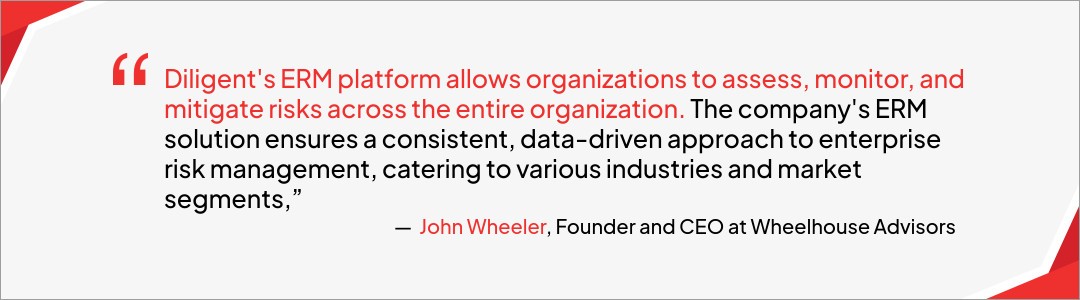
Finding the right solution for your organization is essential and Diligent’s three-tier ERM product suite makes it possible. The ERM product suite offers a range of solutions that scale with clients’ needs as they mature and require more advanced ERM solutions. Download our ERM software buyer’s guide for a complete list of criteria to consider when upgrading your current system.
Enterprise risk management (ERM) is a structured, organization-wide approach to identifying, assessing, managing and monitoring risks that could impact your strategic objectives. Unlike siloed risk management, ERM integrates risk considerations into decision-making across all departments, helping organizations anticipate threats, seize opportunities, and achieve long-term resilience.
Traditional risk management often occurs in silos (e.g., IT, legal, compliance), with each department handling its own risks independently. ERM, by contrast, is enterprise-wide, aligning risk activities with strategic goals and ensuring cross-functional coordination, governance, and reporting. It’s proactive, integrated and future-focused.
In banking, enterprise risk management is a critical function that ensures financial institutions identify, assess and manage risks that could threaten capital, compliance or reputation. These risks include:
Banks must follow strict regulatory frameworks like Basel III and implement robust ERM programs to ensure stability, satisfy regulators and maintain public trust. ERM in this sector often involves advanced modeling, stress testing and real-time risk monitoring.
Spreadsheets are often the starting point for risk tracking, but they come with serious limitations:
Modern ERM software automates and centralizes risk data for better accuracy, accountability, and insight.
Start by assessing your risk maturity — the degree to which your risk practices are defined, repeatable and embedded into decision-making. Key indicators include:
Once you know your maturity level (emerging, developing, integrated, advanced), look for software that:
Some vendors even offer maturity assessment tools as part of their onboarding process.
Look for an ERM platform that offers:
Scalability is not just about size — it’s about supporting your evolving risk culture.
Enterprise-ready ERM solutions should be:
A risk register is a centralized record of all known risks, including their likelihood, potential impact, mitigation efforts, and status. It’s essential for:
ERM software usually includes dynamic, filterable risk registers.
Automated reminders and workflows in ERM platforms help streamline updates.
Yes. ERM frameworks can incorporate environmental, social, and governance (ESG) risks and cyber risks into your organization’s overall risk profile, enabling unified risk management across financial, operational and reputational domains.