
Measuring enterprise risk management (ERM) performance presents challenges for even sophisticated organizations. The goal extends beyond achieving risk management. It's about building governance infrastructure so businesses achieve key objectives while navigating complex regulatory environments.
The challenge has intensified in 2025. According to the KPMG Business Resiliency Survey, only 64% of organizations have integrated risk and resilience into their business strategy and planning. This gap represents billions in potential value creation and protection that remains unrealized.
Understanding ERM performance transcends traditional compliance metrics. Contemporary risk management necessitates quantifying the relationship between ERM strategy and organizational performance. This enables Chief Risk Officers to inform strategic agendas with evidence-based data. To do that, risk teams must understand:
Risk management KPIs (Key Performance Indicators) are quantifiable metrics that measure how effectively an organization identifies, assesses, and mitigates risks across its operations.
While risk management KPIs track historical performance and program effectiveness, key risk indicators (KRIs) provide forward-looking signals about emerging threats. Together, these metrics enable risk leaders to demonstrate ERM value, connect risk management to business outcomes, and provide boards with evidence-based insights for strategic decision-making.
Much of the success organizations enjoy today results from effective ERM. At its core, ERM protects systems, data, assets and competitive advantages. When it works effectively, ERM has myriad benefits beyond the risk function itself. This includes the following:
Drive value beyond risk: Sophisticated ERM can identify opportunities with favorable risk-return profiles and support strategic decision-making that advances business objectives. For growth-stage companies, this means faster transaction readiness. For mid-market organizations, it enables smoother IPO preparation. For enterprises, it delivers the governance excellence required for complex regulatory environments.
While measuring ERM performance remains challenging, success requires selecting appropriate KPIs that demonstrate both risk reduction and strategic value creation. Less mature organizations often struggle with metric selection, while sophisticated programs may track numerous indicators without clear business relevance.
Derek Vadala, Chief Risk Officer at Bitsight Technologies, identifies a critical measurement challenge: "What are the risks you want the board to be focused on? In a lot of situations, whether with ERM professionals or individuals focused on specific risks, people tend to go into the boardroom with metrics and stats and elaborate slides about what's going on in the organization. There tends to be a crush of data before establishing guardrails about what to be worried about."
Effective measurement begins with defining strategic KPIs that connect risk management activities to business outcomes. Successful ERM programs measure predictive indicators, such as risk velocity and mitigation effectiveness, rather than relying on backward-looking compliance scores.
Organizations implementing effective ERM programs should monitor these essential risk management KPIs across their risk portfolio:
These risk management KPIs provide the quantitative foundation for demonstrating ERM value to executives and boards while enabling data-driven risk decisions.
Research from the Internal Audit Foundation and Baker Tilly ERM Maturity Survey reveals a clear performance measurement hierarchy that impacts business outcomes. Organizations that have evolved to strategic risk measurement consistently outperform their peers across multiple dimensions.
The most successful organizations leverage risk information to drive strategic planning. While 86% of strategic planners at these companies actively use overall risk profile data, the sophistication drops significantly for emerging risks analysis (77%) and risk scenario modeling (47%). This measurement sophistication gap explains why some organizations struggle to demonstrate ERM value to leadership — they measure activities rather than strategic impact.
Technology creates a fundamental divide in measurement capabilities. The majority of organizations (59%) still rely on spreadsheets and basic tools that cannot generate the real-time risk metrics necessary for strategic decision-making. In contrast, companies using integrated GRC platforms (21%) or custom in-house solutions (20%) demonstrate better ability to translate risk insights into business strategy.
The measurement approach itself determines organizational outcomes. Companies that establish:
Achieve higher success rates in connecting risk insights to business expansion decisions. These organizations understand that measuring risk management sophistication enables strategic agility rather than constraining growth opportunities.
Most critically, the research demonstrates that organizations measuring ERM through strategic outcome metrics rather than process completion rates achieve superior business results. The 62% of companies that successfully integrate risk information into strategic planning processes significantly outperform peers who measure ERM activities in isolation from business outcomes.
While organizations can measure their KPIs, it’s important to contextualize those KPIs within an accepted ERM model or framework. Because these models are standardized, they act as an objective measurement tool that prevents organizations from — accidentally or otherwise — misrepresenting their ERM performance by reporting only the metrics they’re successful at.
The COSO ERM Framework, for example, focuses on performance, specifically how effective the risk management program is at mitigating risks that threaten the organization’s objectives. Organizations using the COSO Framework should track and measure activities like risk identification, prioritization and mitigation to understand ERM performance.
Other frameworks, like the Casualty Actuarial Society ERM Framework and ISO 31000, include their own assessment approaches.
Measuring ERM performance requires a well-defined process within your ERM strategy. The approach varies by organizational maturity: SMB companies often focus on transaction readiness, mid-market organizations emphasize IPO preparation and scaling governance and risk management, while enterprises prioritize governance excellence and regulatory sophistication.
Here's how to develop clearer pictures of program effectiveness:
Technology is revolutionizing risk performance measurement for enterprise and mid-market organizations. Advanced AI-powered platforms like Diligent address the complexity challenge by enabling risk teams to generate strategic insights from vast data sets rather than relying on manual analysis and basic compliance reporting.
Organizations using Diligent's governance platform achieve measurable ROI by reducing manual effort, accelerating compliance cycles, and enhancing board confidence. Risk leaders successfully recommend Diligent to CEOs by quantifying the efficiency gains, regulatory risk reduction, and accelerated strategic decision-making that governance technology enables.
1. Automated risk identification and tracking: Diligent’s ERM solution continuously monitors regulatory changes and identifies compliance gaps before they materialize into issues, enabling proactive risk management rather than reactive response. This capability proves essential for organizations managing complex multi-jurisdictional requirements or preparing for IPO readiness.
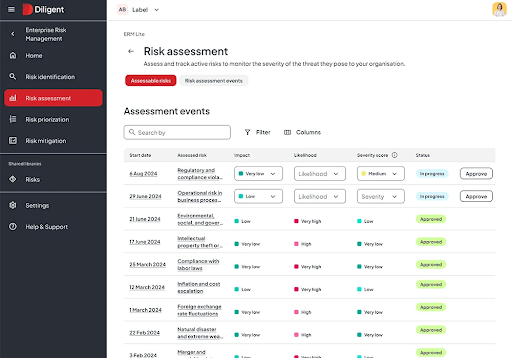
2. Intelligent performance reporting: Diligent’s Smart Builder assembles risk data into executive-ready materials that demonstrate strategic value to boards and stakeholders. Risk teams can transform months of analysis into compelling board presentations with one click, focusing their time on strategic recommendations rather than document preparation.
3. Predictive analytics and benchmarking: AI-powered platforms like Diligent AI Risk Essentials enable real-time performance benchmarking against industry standards and peer organizations. Predictive modeling capabilities forecast potential risk scenarios and their business impact, supporting strategic planning rather than reactive risk response.
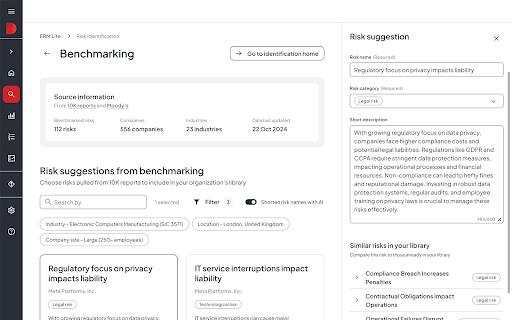
4. Executive-ready ROI reporting: Diligent enables risk leaders to demonstrate governance software value through automated dashboards showing time savings, cost avoidance, and strategic impact metrics. These executive reports translate risk management KPIs into business outcomes that resonate with CEO and CFO priorities, supporting technology investment decisions and program expansion.
Though ERM can easily become reactive, in reality, it should embody the principle that the best offense is a good defense. When an organization is consistently secure, it can pivot to pursue new opportunities and even find gaps in the market — both of which are key to solidifying the competitive advantage.
ERM frameworks provide risk teams with guardrails to communicate performance effectively. With strong risk communication, Chief Risk Officers can guide boards toward making bold moves that don't overexpose businesses to risk. Contemporary governance requires this integration between risk management and strategic opportunity identification.
Ready to build governance infrastructure that supports proactive risk management? Schedule a demo with Diligent today.
The most critical KPIs include risks identified and mitigated, time to mitigation, risk costs, and strategic integration metrics. Focus on metrics that demonstrate both risk reduction and value creation to show comprehensive program effectiveness.
Leading organizations measure core metrics monthly, with comprehensive performance reviews quarterly. However, critical risk indicators should be monitored continuously using automated systems to enable real-time decision-making.
The biggest mistake is measuring activities instead of outcomes. Focus on strategic impact rather than process completion. Also, avoid creating too many metrics without clear business relevance or failing to integrate measurements with strategic planning processes.
Start with 3-5 fundamental metrics aligned with business objectives. Use technology platforms that scale with growth rather than manual processes that become overwhelming. Focus on metrics that demonstrate clear business value to gain leadership support.
Technology enables automated data collection, real-time monitoring, and predictive analytics that manual processes cannot match. AI-powered platforms can synthesize complex risk data into executive-ready insights while maintaining continuous compliance monitoring.
Schedule a Diligent demo to learn more about ERM frameworks and build governance infrastructure that supports both risk management and strategic growth objectives.