
The role is shifting, even if the org chart hasn’t caught up.
You sit close to the decisions that guide how the organization moves. You translate emerging risks into insight leaders can act on, keep responsibilities clear, and anchor discussions in the right context. You often see implications long before they reach the board.
And the scope for GCs and CoSecs is expanding fast. Decisions are accelerating, risks are evolving, and directors expect sharper insight with less prep time. Your role has evolved from coordination to orchestration, from reporting what happened to guiding what needs to happen next.
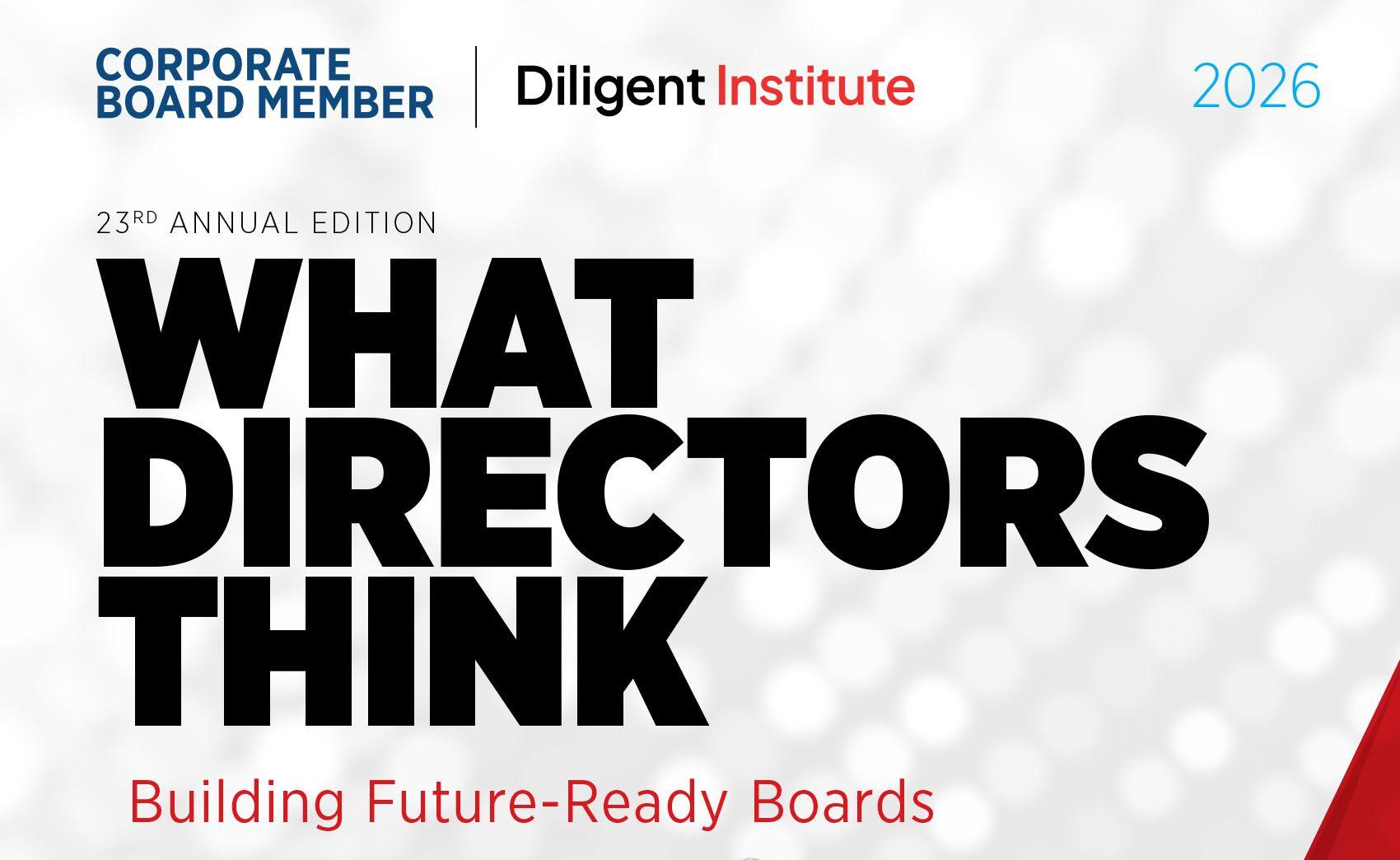
Research from our annual What Directors Think report, produced in partnership with Corporate Board Member and based on responses from 200+ public company directors, reinforces that shift. Most directors want less time spent presenting and more time focused on strategic planning. That change raises the bar on how quickly GCs and CoSecs must turn signals into clear, board-ready insight.
Governance has always required precision, but the dynamics around it have changed. Boards want faster visibility into the risks that matter and expect decisions to come with clear context, not just well‑prepared materials. At the same time, the work behind the scenes has become more cross‑functional. Few issues sit neatly inside one team or one entity anymore.
Yet despite the need for speed, 53% of directors say they still don’t receive real‑time data between meetings. That gap makes it harder to connect emerging signals to the decisions that can’t wait.
Connected governance is how teams close that gap. It turns scattered data into usable context instead of disconnected updates. AI plays a role here, bringing operational value. For AI to support governance, it must save time, reduce exposure, and improve decision quality in ways leaders can stand behind.
That need for defensible use is real. 66% of directors already use AI in their board work, but only 22% say they have clear processes guiding how it’s used. Connected governance addresses that by creating a consistent, secure flow of information that supports both speed and accountability. It isn’t a philosophy. It’s a practical way to keep work aligned when the pace increases and the stakes rise.
For years, digital transformation in the boardroom meant shifting from paper to digital files.
The shift happening now is even larger. Governance is moving away from static artifacts like packs, minutes, and registers, and toward AI‑supported workflows that continuously turn inputs into action‑ready outputs. Information doesn’t just get stored. It moves into the moments where decisions happen, links itself to related context, and becomes easier to reuse without rework.
That’s the difference between passive GRC, where insights sit inside folders, and active, connected governance, where insight shows up when it’s needed. For the GC or CoSec, it’s also the difference between “We have the documents” and “We have the story.”
The most useful way to think about AI in the boardroom isn’t “chatbots in the meeting.” It’s secure intelligence wrapped around governance workflows so teams can work smarter without risking confidentiality.
Here are the capabilities governance teams are relying on now.
Directors don’t want to hunt for context. They want to ask a question and get a reliable answer grounded in the record. AI can support that by searching years of board and committee materials in seconds, responding in plain language, and tying answers back to source documents.
AI removes the resource-sapping searches like “Can you find that slide from last year?” and shifts time toward more meaningful debate. It also closes a major risk gap: When directors can get answers inside a secure environment, they have little reason to turn to public AI tools that don’t protect sensitive governance records.
AI is also reshaping what happens during and after meetings by supporting the workflows CoSecs already use. The most useful capabilities can:
This doesn’t replace the corporate secretary’s judgment. It protects it by removing manual work that limits time for nuance, quality control, and defensibility. Curious how these workflows look in practice? See them in action with a free GovernAI trial.
When governance spans committees, entities, transactions, and multiple executive owners, coordination becomes a risk of its own. Deadlines slip, dependencies get missed, and critical work lands too late. Intelligent planning tools can map topics across the board year, optimize sequencing across committees, and balance availability so the right work reaches the right people at the right time.
In sensitive situations like transactions, investigations, or regulatory reviews, AI‑assisted data rooms can analyze documents, surface patterns, flag anomalies, and cut the manual effort behind complex evidence trails. This is where governance starts to feel less like document management and more like decision readiness.
For many GCs and CoSecs, subsidiary governance is where time disappears. Approvals bounce between inboxes, signatures stall, documents land in different places, signing authority knowledge resides in colleagues’ heads, and visibility breaks down. By the time an audit‑ready trail is assembled for regulators or external counsel, the business has already moved on.
Connecting entity governance directly into the board workflow changes that experience. When both operate in the same flow, teams can:
This is where the idea of a system of action, not just a system of record, becomes real. Entity data stops being a static registry and becomes a predictive governance engine that supports faster decisions, clearer accountability, and fewer compliance surprises.
Join the leaders shaping what’s next in GRC. Elevate 2026 gives you the insights, playbooks and AI know‑how to lead with confidence this year.

One of the biggest structural shifts across organizations is that risk and compliance functions are increasingly rolling up into legal. That puts GCs in a unique position. They’re being asked to prove AI’s operational impact while also owning the enterprise risk narrative in board-ready language.
That dual responsibility demands visibility, alignment, and a clean flow of information between teams. When risk insights can move directly into board planning and materials, it becomes easier to spot patterns early and coordinate cross-functional responses before issues escalate. Instead of stitching together competing updates, the GC can present a unified picture of what matters and what’s changing.
The result is a board that gets one story, not fragmented signals. And the GC becomes the connector who turns governance into forward momentum.
If you want to turn AI-enabled governance from interesting to measurable, start here.
1. Set clear guardrails for AI use
2. Map the GC/CoSec governance stack
Boards, entities, risk, investigations — map where context gets lost and where teams re‑create work. Then:
3. Pilot one AI‑heavy workflow and measure it
Start where the administrative load is highest and the impact is easiest to prove:
Track cycle‑time reduction, rework eliminated, and improvements in risk visibility. Small pilots with clear metrics build momentum fast.
Most governance teams don’t need more AI experiments. They need fewer, better workflows that connect the work, protect confidentiality, and make outcomes easier to measure.
That’s where cohesive intelligence wins — not because it’s louder or more ambitious, but because it’s easier to operationalize across boards, entities and risk.
When governance inputs and board decisions live in one connected flow, it becomes easier to see what matters early, reduce rework, and keep decisions grounded in reliable context.
And at the center of this shift is a simple truth: the GC and CoSec sit at the intersection of every meaningful signal. When governance, risk and compliance all move through the same connected flow, these leaders don’t just keep pace with change. They guide it — and they guide it better together.
Ready to turn connected governance into a concrete action plan? Download our AI-powered governance checklist for corporate secretaries and see the exact steps to modernize board, entity and risk workflows with AI.

How AI-powered tools transform board meeting management

Discover how AI-powered tools are revolutionizing board meeting management by automating complex processes, enhancing efficiency, and enabling directors to focus on strategic decision-making. This guide outlines actionable steps for transforming governance workflows, ensuring compliance, and improving overall effectiveness in board operations.