
In this article

Effective corporate governance is crucial for building and maintaining stakeholder trust within an organization. It encompasses a framework of principles, policies and processes that guide how a company operates ethically, transparently and accountably.
Within this framework, internal audits play a vital role in ensuring that governance practices are sound and deficiencies are identified and addressed. The Institute of Internal Auditors' (IIA) 2025 Pulse Report reveals that 73% of organizations now outsource internal auditing, while only 27% operate without any outsourced audit services — showing how specialized risks are driving organizations to seek external expertise for complex audit areas.
This guide covers everything organizations need to know about optimizing internal audits for corporate governance:
An internal audit acts as an independent and objective evaluator within an organization. It provides assurance to the board of directors and senior management on the effectiveness of various elements that are crucial for good governance, including:
Internal audits assess organizational risk management frameworks, identifying potential threats and evaluating control adequacy for mitigation strategies. For mid-market and enterprise companies managing complex risk environments, this systematic approach provides essential efficiency in resource allocation and strategic decision-making.
Cybersecurity has emerged as a dominant governance priority, with most audit committees now identifying it among their top concerns. Internal audit functions must now provide specialized assurance on emerging risks, including AI governance, data privacy, geopolitical threats, and third-party vendor management.
This proactive risk identification provides essential support for strategic decision-making and helps organizations allocate resources effectively across their most critical threat areas.
Internal audits evaluate the design and operating effectiveness of internal controls across financial reporting, operational activities, and compliance processes. This evaluation ensures accuracy and reliability of information while safeguarding against fraud, errors, and operational failures that could impact stakeholder confidence.
With the SEC designating AI as a disclosure priority and requiring company-specific risk disclosures, internal audit assists in verifying adherence to evolving regulatory requirements across multiple jurisdictions. This includes compliance monitoring for Sarbanes-Oxley requirements, GDPR data protection, climate disclosure mandates, and emerging AI governance frameworks.
Internal audit reviews the design and effectiveness of governance processes, including board composition, board procedures and communication channels. This ensures transparency and accountability within the organization's leadership structure.
An internal audit function that supports good governance possesses several key characteristics that align with the IIA's 2024 Global Internal Audit Standards:
Running an internal audit department today is far from easy. Discover the four steps to building an optimized audit infrastructure, with a detailed checklist to guide your journey.

A strong ethical culture is central to good governance, fostering trust, transparency and responsible decision-making. Internal audits promote organizational integrity through several key mechanisms:
Effective collaboration between internal auditors and the board is critical for optimizing the internal audit function's contribution to good governance. For internal audit functions managing complex risk environments, this collaboration becomes essential for establishing robust governance frameworks required by stakeholders. This collaboration can be facilitated through:
Timely communication between internal audit teams and boards enables directors to stay informed of key findings, risk assessments, and emerging compliance issues. This includes quarterly reporting cycles plus immediate escalation for critical matters requiring board attention.
Internal audit committees should meet regularly with the board in executive sessions — without management present. These private discussions allow for frank conversations about management performance, cultural concerns, and sensitive issues that might not surface in regular meetings.
Internal audits help keep board members current on evolving threats and regulatory changes that affect the organization. This includes briefings on new cybersecurity risks, regulatory updates, industry-specific threats, and best practices from other organizations that directors can apply to governance oversight.
Direct internal audit access to the board without management intervention ensures independent reporting and facilitates transparent communication about governance matters, control deficiencies, and organizational culture issues.
Internal audits should tailor audit plans and activities to address specific board priorities and concerns regarding risk management, governance effectiveness, and regulatory compliance.
Internal audits continue evolving alongside changing business environments and regulatory requirements. Recent regulatory developments are driving specific changes in the internal audit’s focus and capabilities:
Internal audit functions must quickly adapt as regulatory requirements change. For example, Corporate Transparency Act requirements were suspended for U.S. domestic companies in March 2025, reducing compliance burdens but requiring internal audit teams to rapidly adjust their monitoring programs. These constant regulatory shifts — both adding and removing requirements — demand agility from internal audit functions.
The Public Company Accounting Oversight Board’s amended auditing standards emphasize internal controls over technology and electronic evidence reliability. Internal audit must assess how organizations and external auditors adapt to new expectations for digital audit evidence, documentation standards, and evidence validation as more processes move to electronic systems.
Rising regulatory expectations for AI-related risk disclosures in 10-K filings mean internal audit must ensure accurate, complete AI risk reporting. This includes assessing governance over AI systems, evaluating related controls, and managing risks like "AI washing," data integrity issues, and third-party AI exposures.
Internal audits are shifting from periodic, sample-based testing to continuous, comprehensive data analysis. Modern audit teams now use automated tools that analyze 100% of transactions rather than statistical samples, enabling them to detect anomalies and control failures immediately rather than months after they occur.
This evolution requires internal auditors to develop new technical skills in data analytics, understand automated testing tools, and redesign audit programs around continuous assurance rather than point-in-time reviews.
Internal audit roles are broadening beyond financial and operational risks to include environmental, social, and governance measurements. With EU sustainability reporting mandates, internal audit teams must now verify carbon emissions calculations, assess supply chain sustainability claims, and provide assurance over ESG data quality.
This expansion requires auditors to understand new measurement standards, develop expertise in sustainability metrics, and coordinate with environmental teams — skills that weren't traditionally part of internal audit competencies.
Internal audit functions face mounting pressure to provide strategic insights while managing expanding risk portfolios and shrinking timeframes. Traditional manual processes can't keep pace with the volume of data, regulatory complexity, and board expectations for real-time risk intelligence.
This operational reality requires technology infrastructure that can transform raw data into actionable audit insights while maintaining comprehensive coverage across complex organizational structures. To achieve this goal, best-in-class governance tools like Diligent provide:
Diligent's enterprise risk management solution continuously identifies compliance risks across regulatory frameworks, providing real-time alerts for emerging threats requiring immediate audit attention. This proactive approach enables internal audit teams to address potential issues before they develop into significant governance problems or regulatory violations.
Diligent’s ACL Analytics transforms audit data analysis with advanced pattern recognition and anomaly detection capabilities that analyze 100% of transactional data rather than traditional sampling methods. This coverage enables internal audit teams to identify control failures, fraud indicators, and process inefficiencies with greater accuracy and speed.
Diligent Audit Management provides smart audit planning capabilities that optimize resource allocation based on risk assessments, regulatory priorities, and business objectives. Automated documentation and reporting capabilities ensure audit findings translate into actionable recommendations for management and board oversight.
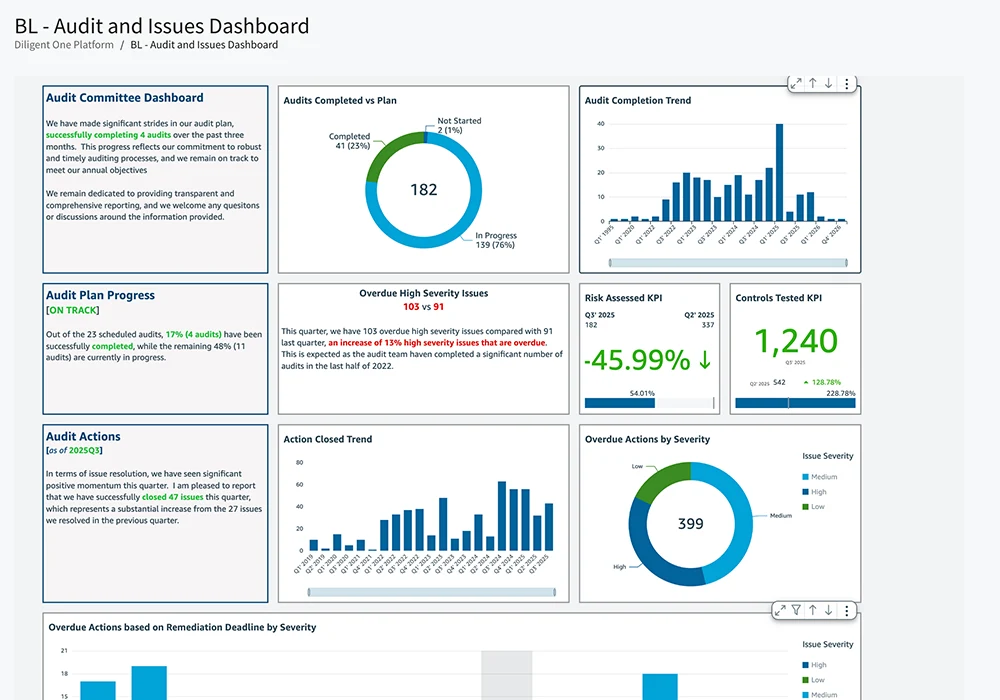
Diligent integrates these AI capabilities with audit management, automated compliance tracking, and real-time reporting that support both regulatory requirements and strategic decision-making.
Internal audits serve as the critical bridge between board oversight and operational reality, providing independent assurance that governance actually works in practice. Effective internal audit functions don't just find problems — they prevent governance failures that can destroy stakeholder confidence and business value.
The most successful organizations are moving beyond traditional audit approaches to AI-powered continuous monitoring that identifies risks before they become crises. Smart audit management delivers comprehensive data coverage, automated compliance tracking, and real-time risk intelligence that transforms internal audit from a compliance function into a strategic business advantage.
Ready to see how AI transforms internal audit effectiveness? Schedule a demo to discover how Diligent's solutions can strengthen your governance infrastructure and deliver measurable business impact.
Internal auditing should provide regular updates to the board, typically quarterly, with immediate reporting for critical issues. The IIA's 2024 Global Standards emphasize continuous communication rather than just formal reporting cycles.
Internal audits provide ongoing assurance and advisory services to management and the board, while external audit focuses on annual financial statement attestation. Internal audit has a broader scope, including operational effectiveness and risk management.
Key metrics include audit plan completion rates, management acceptance of recommendations, and stakeholder satisfaction scores. Organizations also measure the function's ability to identify emerging risks before they impact operations.
Best practice requires dual reporting — administratively to senior management for daily operations, while maintaining functional reporting to the audit committee. This structure preserves independence and objectivity.
CAEs should possess relevant professional certifications (CIA, CPA, or similar) and extensive risk management experience. They must demonstrate leadership capabilities to effectively communicate with boards and senior management.
Schedule a demo to discover how Diligent can transform your internal audit effectiveness today.