Despite AI’s rapid adoption across all corners of business, its place in the boardroom remains a topic of debate. Can it — and should it — be trusted to influence governance at the highest levels of an organization?
For board directors, executive leadership and governance professionals, AI’s role in such high-stakes decision-making raises valid concerns. What if AI gets it wrong? What about data security? Could AI-generated insights introduce bias instead of clarity?
These concerns are understandable, and skepticism is both reasonable and necessary. But here’s the reality: AI is already enhancing governance workflows, streamlining board processes, and enabling more efficient, transparent, and data-driven decision-making. And it’s doing so through purpose-built AI solutions designed specifically for governance — ones that prioritize security, transparency, and ethical use.
Before we attempt to put the debate to bed once and for all, let’s unpack some of those very legitimate concerns you may still have about using AI in the boardroom.
Governance demands absolute trust. The information shared at the board level is highly sensitive, and the decisions made in the boardroom based on that information can have far-reaching consequences for organizations, shareholders, customers and the wider public.
So, it’s no surprise that AI in governance is met with some hesitation. Among the biggest concerns include objections like:
These are real concerns — and they demand real solutions.
Gain the knowledge to future-proof your board with powerful tools that securely harness AI. Don’t wait — get access to the FREE AI Innovation Summit today!

The good news? AI can be a trusted for governance — but only when boards leverage purpose-built AI tools designed with the highest standards of security, privacy, accuracy and oversight.
Here are three essential considerations you must consider before exploring the possibilities.
Generic AI models can be risky because they learn from vast, mixed datasets. That’s unacceptable for governance. Instead, boards need AI that is trained solely on their own data, ensuring insights remain private, contextual, and relevant — never shared or influenced by external information. Example in action: AI-powered board management software can extract key insights from board materials, generating AI Board Book Summaries and strategic highlights — without ever pulling in outside data.
Boards need to see at a glance what AI has generated versus what is human-created. This ensures directors stay in control of decision-making, using AI as an advisor, not an authority. Example in action: With tools like AI Smart Prep at their disposal, directors can receive AI-generated questions and talking points instantly from their board pack, but every output is clearly marked, ensuring they know exactly where insights are coming from.
AI should enhance security, not introduce risk. Boards should adopt AI platforms that comply with top-tier security protocols and ensure governance data remains protected from external threats.
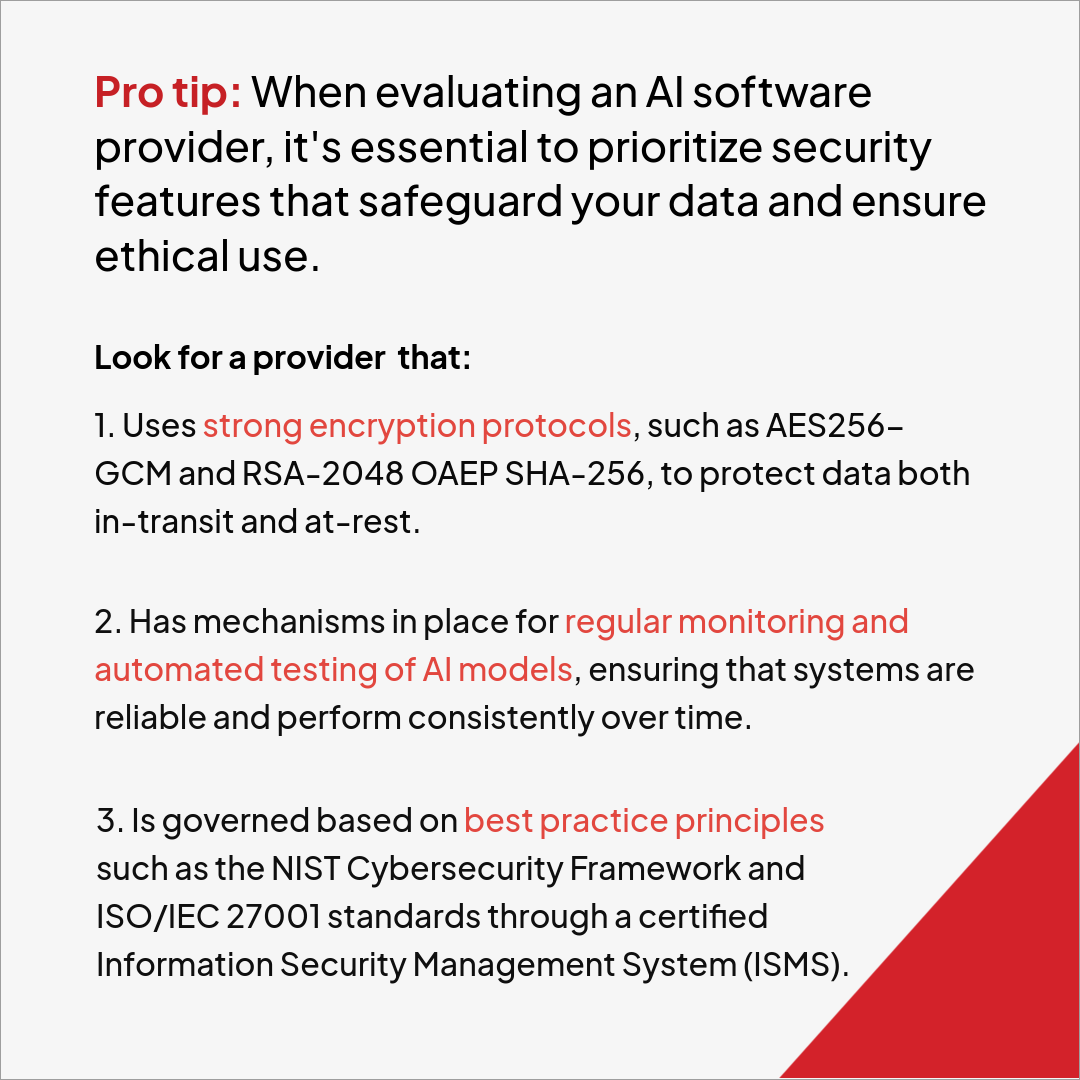
AI should never be a black box in governance. When boards use AI responsibly — with purpose-built tools designed for security, transparency, and ethical oversight — it can become a powerful asset, not a risk.
For governance professionals, the question isn’t whether AI can be trusted. It’s how to use AI in a way that earns and sustains trust. By choosing AI solutions that prioritize confidentiality, clarity, and compliance, boards can move forward with confidence — leveraging AI to enhance human decision-making.
Ready to explore AI-powered governance, but without the risks? Request a demo of the Diligent One Platform today.
Discover how AI-assisted board management software can boost your board’s efficiency, decision-making and planning with tools to use before, during and after the board meeting.