
In the boardroom, where decisions shape the trajectory of organizations, the allure of AI-powered tools has never been stronger. Promising to transform decision-making with data-driven insights and operational efficiencies, AI has become a key discussion point for governance professionals and board directors.
Yet, the reality of AI’s capabilities is often clouded by myths and misconceptions. For boards and leadership teams pondering the adoption of AI to aid with boardroom tasks and governance workflows, separating fact from fiction is critical when building a business case for such tools.
Here, we’ll debunk four common myths about AI in decision-making and provide a clearer picture of how this transformative technology can (and cannot) serve boards effectively.
AI excels at analyzing vast amounts of data, identifying patterns, and providing insights that might otherwise go unnoticed. However, board decisions often hinge on nuanced judgment, ethical considerations, and a deep understanding of context — areas where human directors are indispensable. AI tools should be viewed as complements to human expertise, not substitutes.
Example in action: The latest AI-powered board management software effortlessly extracts key insights from extensive board book content, distilling it into pointed questions and talking points. This empowers directors to spend less time digesting dense material and more time concentrating on meaningful discussions and informed decision-making. However, it is ultimately the board’s collective experience and strategic foresight that chart the best course of action.
Generative AI's potential for bias or hallucination does not mean it cannot be trusted in decision-making. While concerns about inaccuracies in AI are valid, they can be mitigated by choosing AI solutions that prioritize data integrity and transparency. Boards must ensure that the AI tools they use are purpose-built for governance, with stringent safeguards to secure sensitive information, prevent misuse and the propagation of bias, ultimately ensuring reliability when navigating complex governance challenges.
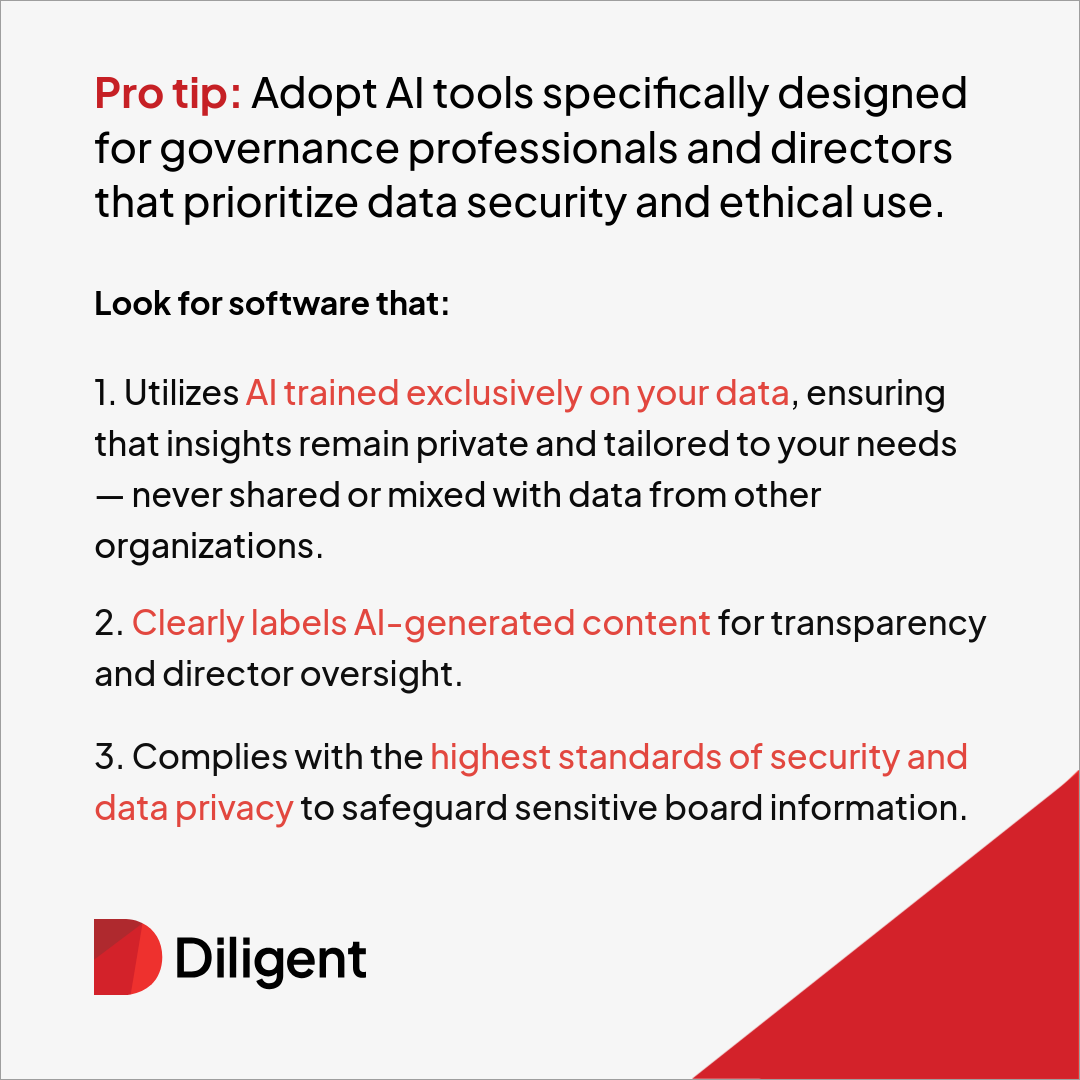
By choosing purpose-built AI with these principles, boards can confidently leverage AI's strengths without compromising their standards or security.
The best AI-powered solutions for boards focus on user-friendly interfaces and practical applications. Directors do not need to be data scientists to leverage AI effectively; they simply need tools that present insights in a digestible and actionable format. Many board management platforms incorporate AI features that seamlessly integrate into existing workflows.
Features to look for:
Far from adding risk, AI can bolster compliance efforts by identifying potential regulatory breaches, automating monitoring processes, and maintaining robust audit trails. When adopted responsibly, AI becomes a tool for reducing operational and reputational risks, particularly for public companies or those in industries facing intense regulatory scrutiny.
Example in action: AI-powered comparison tools can accelerate benchmarking and removes manual errors from industry and competitive analysis, ensuring accuracy in compliance reports and filings.
To harness the full potential of AI while avoiding pitfalls, boards should:
AI holds immense promise for enhancing boardroom decision-making, but it’s not a magic bullet. By dispelling myths and embracing the reality of AI’s capabilities, boards can make informed choices about how to integrate this powerful technology into their governance practices. The key lies in using AI to augment, not replace, human expertise—ensuring that directors remain at the heart of strategic decision-making while leveraging AI to enhance their impact.
Ready to explore how AI can transform your board’s decision-making process? Request a demo of our AI-powered board management platform today.
Discover how AI-assisted board management software can boost your board’s efficiency, decision-making and planning with tools to use before, during and after the board meeting.