

In today’s polarized, fast-moving and highly scrutinized public environment, technical competence and policy knowledge alone are no longer sufficient for effective leadership. Elected officials are increasingly being called upon not just to govern, but to lead through relationships. This is where relational leadership becomes not just relevant, but essential.
Relational leadership is grounded in the understanding that leadership is not primarily about authority, position or control — but about influence, trust, connection and shared purpose. For elected officials, whose legitimacy is derived from the public they serve, relational leadership is not optional; it is foundational.
Traditional models of leadership emphasized hierarchy, command and compliance. Leaders made decisions, others followed. While this approach may have worked in stable environments, it is poorly suited for today’s complex and adaptive challenges.
Relational leadership recognizes that:
For elected officials, this shift is particularly important. Governance does not occur in isolation, it occurs in relationship with constituents, fellow board or council members, administrators, staff and the broader community.
Relational leadership reframes the role of elected officials from “decision-makers only” to stewards of relationships, culture and collective outcomes.
Trust is the cornerstone of relational leadership. Without trust, communication breaks down, collaboration falters and even well-intended decisions are met with skepticism or resistance.
Timothy R. Clark’s work on psychological safety reminds us that people must feel safe to:
In a governance context, this means creating boardrooms and public spaces where:
Elected officials who cultivate this environment strengthen not only their board or council, but public confidence in the institution itself.
A healthy governance culture does not emerge by accident, it is intentionally built. Research and practice consistently show that high-performing boards share several relational characteristics:
Patrick Lencioni’s work on the Five Dysfunctions of a Team reinforces that trust is the foundation upon which productive conflict, commitment, accountability and results are built.
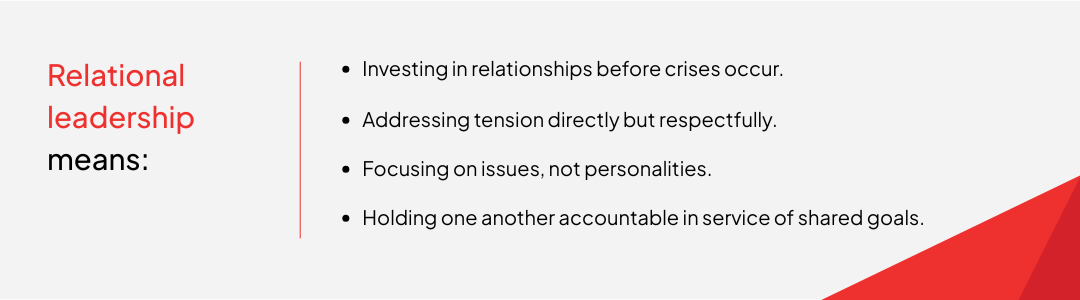
For elected officials, relational leadership means:
This is not about being “nice” or avoiding hard conversations, it is about engaging in those conversations in ways that preserve dignity, strengthen alignment and move the work forward.
Relational leaders understand that influence is more powerful — and more sustainable — than authority. Kouzes and Posner’s research emphasizes that when leaders are at their best, they exhibit five key practices:
For elected officials, this translates into:
When influence replaces coercion, governance becomes a collaborative enterprise rather than a positional contest.
Relational leadership is particularly critical for board chairs and presiding officers. Their role is not merely procedural — it is profoundly relational.
Effective governance leaders:
This relational stewardship shapes the culture of the entire organization. When the chair models humility, curiosity and respect, others follow. When they model defensiveness or dominance, dysfunction multiplies.
For elected officials, relational leadership extends far beyond the boardroom. It is most visible in how leaders engage with their communities.
Relationally strong elected officials:
Community engagement is not a public relations function, it is a relational practice. When leaders consistently engage with authenticity and respect, even difficult decisions are more likely to be understood, if not universally supported.
One of the most misunderstood aspects of relational leadership is accountability. Some assume that a relational approach avoids conflict or consequences. In reality, relational leadership demands more accountability, not less, because accountability is framed around shared purpose and mutual respect.
Relational leaders:
This approach strengthens performance while preserving trust, an essential balance for elected officials navigating complex public systems.
Exceptional elected leaders recognize that leadership is a practice, not a destination. They embrace:
Relational leadership requires leaders to be learners — open to critique, willing to adapt and committed to growth. This posture not only enhances effectiveness but models the very behaviors we seek in our organizations and communities.
Relational leadership is not abstract, it produces tangible outcomes. Exceptional boards and elected bodies consistently (Schroeder and Saron, 2003):
These are not merely technical practices, they are relational commitments.
At a time when public trust in institutions is fragile, relational leadership offers a powerful path forward. It humanizes governance. It restores credibility. It creates conditions where difficult work can happen with integrity and respect.
For elected officials, relational leadership is not about soft skills, it is about core leadership competence.
Because ultimately, leadership is not measured by how many decisions we make, but by the trust we build, the cultures we shape, the people we empower and the outcomes we achieve together.
And in that work, relationships are not secondary — they are the work.
To go even deeper into this topic, join Steve and his governance team colleagues from Sun Prairie Area School District who will be hosting a half-day pre-conference session, Leading with Purpose: Governance Workshop for Education Leaders as an optional add-on to Elevate 2026. The interactive workshop is designed for three governance roles to participate together, creating a shared learning experience and aligned outcomes. It includes practical frameworks, real-world insights and peer discussion focused on ethical leadership, accountability and future-ready decision-making.