
The NIS2 Directive came into force in January 2023, and member states were tasked with implementing NIS2 into national law by October 2024. Although there have been some delays in national laws, NIS2 is not going away. An estimated 160,000 companies plus their supply chain ecosystems will be impacted across the EU.
As someone who has been deeply involved with the NIS2 Directive, and data protection and compliance more generally, I've seen first-hand how the NIS2 Directive has the potential to transform cyber-resilience management across Europe and countries that fall under its extraterritorial application. The need for enhanced governance and accountability, implementation of robust risk-management, cybersecurity measures and improved supply chain security has never been clearer.
In this article, I want to go beyond the surface-level NIS2 discussions that fill our feeds. I will share a real-world perspective on what the Directive means for EU organisations and those serving the European market. This Directive is not just about meeting new requirements. It demands a strategic evaluation of how we approach cyber risks across the eighteen applicable high-criticality and other critical sectors, and their supply chains, including those not established within the EU.
We will explore my five key takeaways of NIS2, their significance for your organisation and how you can effectively address the challenges they present.
Align your CISO, GC, and board for smarter cyber risk management. Discover practical insights and strategies to bridge the gaps between security, legal, and board leadership.

The NIS2 Directive establishes clear responsibilities for senior management to ensure compliance with cybersecurity measures and reporting:
Key steps
Simplify NIS2 compliance and transform regulatory challenges into growth opportunities with our NIS2 IT Compliance Toolkit.

Beyond the financial penalties, non-compliance can lead to a loss of reputation for the organisation, resulting in reduced market penetration and negative media attention. If regulators report non-compliance, the associated negative media coverage can further damage the organisation's reputation.
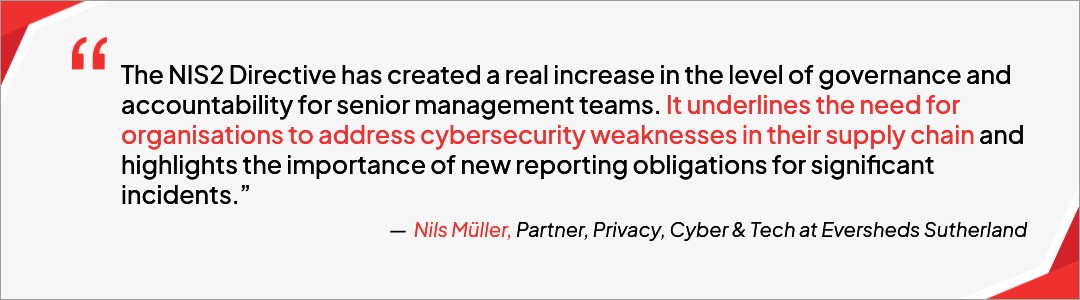
Nils Müller, Partner, Privacy, Cyber & Tech at Eversheds Sutherland, emphasises the impact of NIS2’s requirements:
As a by-product of this, there is a real opportunity to weave cybersecurity into the fabric of your company’s operations: Integrating cybersecurity at leadership level will help align the function with broader business goals, fostering a culture of security awareness. This is essential for ensuring your organisation reduces cyber incidents effectively while supporting business continuity and resilience.
Under the NIS2 Directive, organisations must now implement minimum cybersecurity measures while considering the state-of-the-art.
Key steps
Nils recommends mapping a control library to these measures:

Steps for compliance
1. Classification assessment: Organisations must first determine if they qualify as essential or important entities by conducting a thorough assessment. This involves analysing sector involvement, staff numbers, financial thresholds, and group structures.
2. Sector inclusion: It's crucial to understand the broad scope of sectors included under NIS2. For example, entities in the digital infrastructure sector with more than 50 employees may be classified as important entities, regardless of financial metrics. As a high-level guide:
Whether you are an essential or important entity, meeting the requirement for cost-effective, state-of-the-art cybersecurity measures is a complex but vital process. Beyond ensuring the handling and prevention of security incidents, adhering to this regulation will help your organisation use innovative security practices in everyday operations. This will directly and positively impact long-term business continuity and resilience.
Download our NIS2 checklist for the actionable steps your organisation can take to comply and elevate your cyber security resilience.

Supply chain security is a huge challenge for the ecosystem. There is growing cyber inequity between organisations that are cyber resilient and those that are not. Large highly regulated organisations have demonstrated gains in cyber resilience, but the same is often not true for smaller less regulated organisations. This means that smaller organisations are increasingly unable to prevent critical operational disruption from a cyber incident, often incur larger financial loss when seeking to recover, and find compliance with customer contractual obligations very difficult.
The result is targeted attacks on the supply chain, which often have less mature cybersecurity risk management and attack response measures. Bad actors then use this access to target larger entities that rely on these suppliers for products or services.
Addressing cybersecurity weaknesses within supply chains is a crucial mandate under the NIS2 Directive. This pain point of supply chain due diligence will only increase as large organisations contractually impose NIS2 onto their direct supply chains.
So, how can your organisation proactively approach this challenge?
Key steps
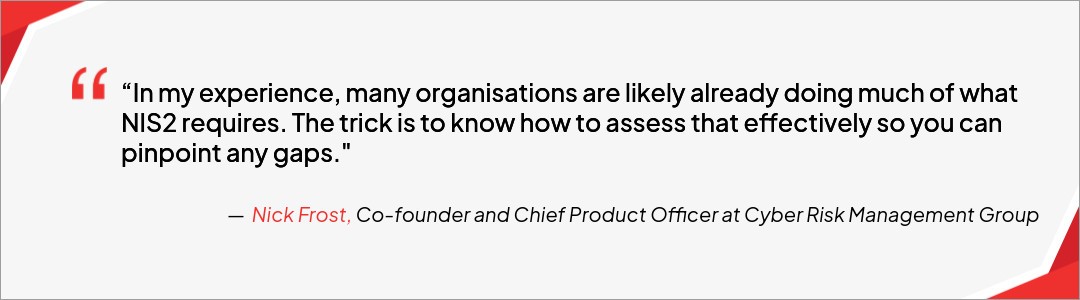
Nick Frost, Co-founder and Chief Product Officer at Cyber Risk Management Group, reminds us, "Securing the supply chain is probably one of the biggest challenges organisations and security functions face.” But if we look to find a positive with the impact of NIS2; by embedding cybersecurity standards into supply chain contracts, you ensure consistent security practices, mitigate vulnerabilities, and reduce cyber incident disruptions. Ultimately, a proactive approach to the NIS2 Directive will strengthen your reputation and customer trust, positioning your organisation as a leader in cybersecurity diligence.
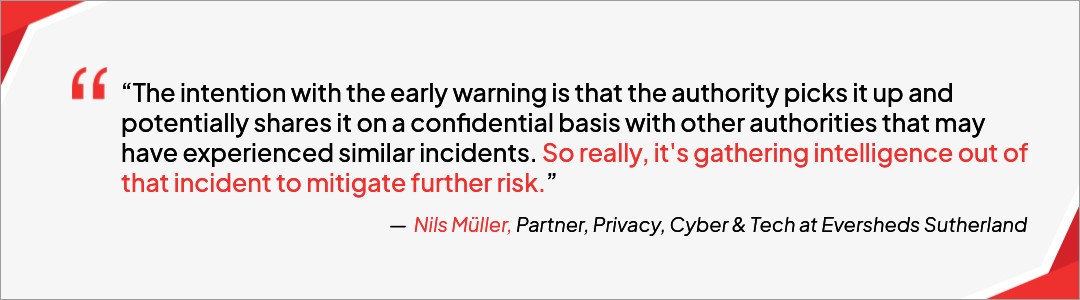
Your organisation’s role in managing cybersecurity incidents takes on a new level of urgency and importance under the NIS2 Directive. As an essential or important entity, you must now follow stringent reporting obligations when a significant cybersecurity incident is detected:
Key steps
Again, there is a positive long-term outcome: your organisation will develop an enhanced cybersecurity framework. By preparing effectively so you can adhere to these reporting obligations, you are doing more than following protocol. You are actively protecting your organisation – and your customers and partners - and bolstering its resilience against cyber threats.
The NIS2 Directive doesn't only apply to EU established entities; it reaches out globally with extra territorial application, mandating requirements and obligations for international entities that offer services within the EU market. This move ensures that any entity, regardless of its geographical location, adheres to stringent cybersecurity norms if it serves the EU market. It also means that EU entities cannot contract out of their obligations by leveraging non-EU partners who do not need to adhere to the NIS2 requirements.
Key steps
Advice to non-EU businesses
By setting a new standard in cybersecurity, the NIS2 Directive ensures that above and beyond a compliance exercise, cybersecurity becomes an integral part of an evolving organisational cybersecurity strategy that places an increasing focus on operational resilience.
Before your executives and board members can lead on NIS2, they must develop expertise and best practices. The NIS2 training courses available through the Diligent One Platform provide a comprehensive understanding of the directive, offering guidance on compliance obligations and key provisions, and include practical tools like a preparation checklist to ensure thorough readiness. As you prepare to meet its ongoing requirements and obligations, concentrate on developing a robust framework that not only meets immediate compliance needs but also improves long-term resilience across your supply chain.
Get armed with everything you need to easily map, manage, and demonstrate your NIS2 compliance with a scalable method for managing future risks. Find out more about our NIS2 Toolkit and book a demo here.