In this article

We asked legal leaders the top risks on their minds this quarter: Regulatory change, AI risk and cyber threats all demand clear owners, working frameworks and tested capabilities.
These key risks run throughout the latest GC Risk Index from Diligent Institute in partnership with Wilson Sonsini. Drawing on a survey of 200+ general counsel, chief legal officers and senior legal leaders, the GC Risk Index 2026: Legal leaders navigating governance gaps in AI, cyber and regulatory risk tracks how the risk landscape has changed since Q2 and where governance maturity, board readiness and cyber preparedness currently stand.
Respondents rate the current risk level at 6.6 out of 10, with 59% placing it between 7 and 10. Across every edition we've published, including the Q4 2025 GC Risk Index, risk has held consistently in the upper range.
The composition has shifted considerably from Q2: Regulatory change now leads at 55%, with AI-related risk at 49% and cyber threats at 47%. Geopolitical conflicts, which led the Q2 register at 52%, have dropped to 26%.
Managing regulatory change, AI oversight and cyber readiness means making decisions, assigning owners and building capabilities. For legal teams, that shift in the risk register represents a meaningful expansion in what the function is being asked to weigh in on, or even to own.
Fifty-nine percent of respondents say AI adoption is outpacing governance in their organization, with 41% having no formal approach or still in early policy development. Only 21% are continuously reviewing and updating their processes.
The open-ended responses show what that variance looks like in practice: Some organizations have formal approval workflows, enterprise licenses and pre-approved tool lists. Others are managing on informal conversations or haven't acted yet.
One finding complicates the picture further. About 65% say emerging AI-specific regulation has only slight or no influence on their AI governance approach. Regulatory change is the top overall risk factor in this survey, yet most organizations aren't building AI governance in response to incoming regulation. They're making internal decisions without an external reference point, with accountability often defaulting to Legal.
Board readiness adds another dimension. The Q4 data puts average board AI readiness at 2.9 out of 5, with only 26% of respondents rating it 4 or 5. For legal teams working to raise AI risk onto board agendas, the tools directors use to engage with those materials matter. Consumer tools that leave no governance record won't cut it: Directors need a governed, auditable environment, one where every interaction is logged and answers are drawn from materials they're already authorised to see.
Sixty-seven percent of legal teams are reviewing vendor terms, data use, privacy, confidentiality and IP issues before AI tools are deployed. But only 23% regularly brief the board or senior leadership on AI-related risks. Legal holds primary responsibility for AI governance in a small minority of organizations.
The pattern is consistent: Legal is active in AI, but largely at the review and compliance stage rather than the strategy stage. It's involved in checking what gets deployed, less often in deciding what gets bought, what data it processes or what the board is told about the risk picture.
That positioning matters more than it might appear. By the time a tool is selected, the data architecture is set and the vendor terms are signed, the decisions that create the most governance risk have already been made. Legal reviewing contracts downstream doesn't change that. Organizations where legal teams are shaping the AI agenda earlier, including what gets escalated to the board, are better placed to catch exposure before it becomes a problem.
Twenty-nine percent of respondents report a third-party or vendor cyber incident in the past twelve months. Only 34% are very confident their organization could meet regulatory disclosure deadlines following a material cyber event, with fully tested protocols in place. A further 54% have protocols, but haven't stress-tested them.
Strong internal controls don't insulate an organization from a supplier's incident, and disclosure deadlines don't move to accommodate teams that aren't ready. A response plan that hasn't been stress-tested offers less certainty than most teams assume. Most vendor programs are built on periodic assessments, which means changes in a vendor's risk posture between review cycles can go undetected until they've already become a problem.
Stress-test your disclosure protocols. Fifty-four percent of organizations have cyber incident response plans they haven't tested. A tabletop exercise with a realistic third-party scenario is the most direct way to find the gaps before they matter. Getting GC and CISO aligned on how an incident gets escalated and disclosed is part of that preparation.
Map who owns AI risk. Forty-seven percent of organizations place AI governance with IT, Security or a data/digital function, with Legal in an advisory role. If ownership isn't clear across those functions, that conversation is overdue.
Put AI risk on your board agenda. Average board AI readiness sits at 2.9 out of 5, and only 23% of legal teams regularly brief the board on AI risk, which means there's room to lead. Boards want to be led on this and translating AI risk into fiduciary language is legal work.
The full GC Risk Index 2026: Legal leaders navigating governance gaps in AI, cyber and regulatory risk covers AI governance maturity, board readiness, shadow AI, cyber resilience and disclosure preparedness in detail. Download it to take the findings into your next board conversation or governance review.
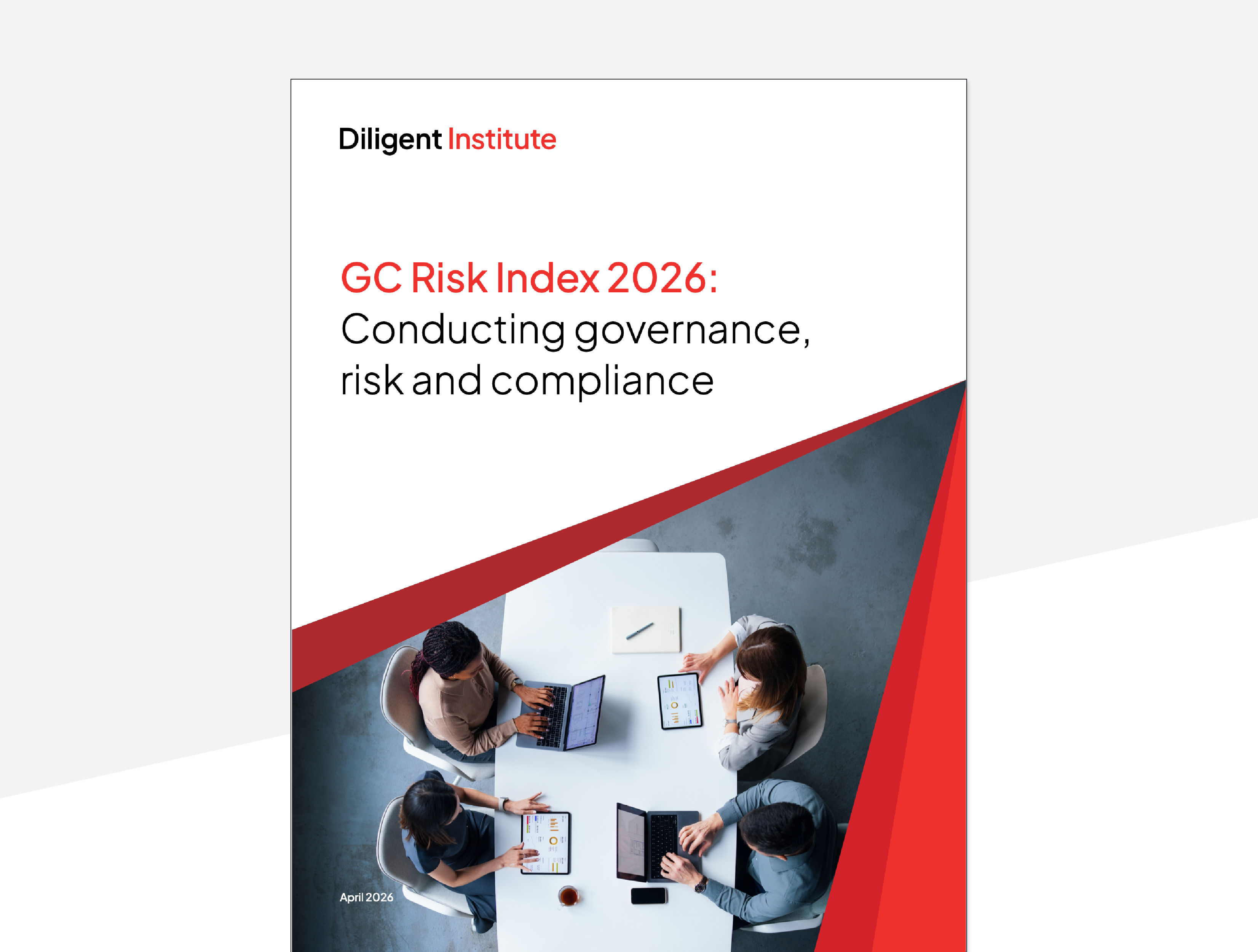
General Counsel Risk Index: Global risk benchmarking for legal leaders
Gain critical insights into global risk benchmarking with the latest General Counsel Risk Index, which synthesizes data from 147 senior legal leaders. This report will help you assess your organization's risk posture, enhance governance, risk, and compliance strategies, and prepare for informed discussions with your board and C-suite. Download now to access essential benchmarks and elevate your legal leadership role.

AI action plan worksheet for public sector GRC leaders
Download this essential AI action plan worksheet for public sector GRC leaders, designed to help you navigate the complexities of AI implementation in governance, risk, and compliance. This practical 90-day template guides you in setting clear goals, assessing AI maturity, prioritizing use cases, and establishing necessary oversight to ensure transparency and accountability. Take the first step towards a controlled and evidence-ready approach to AI in your organization.