
For SaaS companies pursuing enterprise customers, security certifications have become table stakes. But managing multiple frameworks — SOC 2, ISO 27001, FedRAMP and beyond — creates operational complexity that drains resources and delays revenue.
A cloud controls framework solves this challenge by establishing unified security controls that simultaneously satisfy multiple certification requirements, transforming compliance from a cost center into a competitive advantage.
The principle is straightforward: Build controls once, certify many times. When organizations design controls to satisfy the common requirements across frameworks, they eliminate duplicate documentation, consolidate evidence collection and streamline audit preparation.
Instead of treating each certification as a separate project, a unified framework captures the significant overlap between standards, enabling faster time-to-certification and sustainable compliance that scales with business growth.
This article covers everything you need to know about implementing a cloud controls framework for certification efficiency:
A cloud controls framework is a structured set of security policies, procedures and technical safeguards designed to protect data and systems in cloud environments while satisfying the requirements of multiple regulatory and certification standards.
Rather than implementing separate controls for each certification, organizations design unified controls that map to common requirements across frameworks.
When properly implemented, a single access control policy can simultaneously satisfy requirements under SOC 2, ISO 27001, NIST CSF and HIPAA, eliminating redundant work while strengthening the overall security posture.
Security standards like SOC 2 or ISO 27001 define what organizations must achieve. A cloud controls framework defines how organizations implement and demonstrate those requirements efficiently.
The framework serves as the operational layer that translates multiple standards into practical, testable controls.
Consider the difference:
A common controls framework consolidates these overlapping requirements into a single access management control with evidence collection that satisfies all three standards.
While closely related, these terms serve different contexts. A common controls framework (CCF) is the broader concept: a unified approach to managing controls across any regulatory requirements.
A cloud controls framework applies this approach specifically to cloud computing environments, addressing the unique security considerations of cloud infrastructure, shared responsibility models and cloud-native services.
For SaaS companies, the cloud controls framework incorporates both the CCF methodology and cloud-specific requirements like data residency, encryption in transit and at rest, and cloud provider security configurations.
Building a cloud controls framework requires upfront investment. The return comes through accelerated certifications, reduced operational costs and strategic business benefits.
Organizations pursuing certifications separately face compounding timelines:
Add HIPAA, PCI DSS or FedRAMP, and the cumulative timeline extends well beyond what growth-stage companies can afford.
A unified framework compresses these timelines by enabling parallel certification efforts. Controls designed for multiple frameworks simultaneously satisfy overlapping requirements. The same access review process that demonstrates SOC 2 compliance also supports ISO 27001 and HIPAA requirements.
Every certification requires evidence collection, stakeholder interviews and auditor engagement. Separate certification programs mean separate audit cycles, multiplying the burden on already stretched compliance and security teams.
A common controls framework consolidates evidence collection. When a single control satisfies multiple requirements, organizations collect evidence once and apply it across frameworks. This reduces not only the direct audit burden but also the operational disruption that comes from constant auditor engagement.
Enterprise sales cycles increasingly depend on security questionnaire response speed. Buyers submit detailed security questionnaires before procurement decisions and slow responses can delay deals or lose them entirely.
Organizations with mature cloud controls frameworks can respond faster because their internal controls documentation is centralized and current. Rather than scrambling to gather evidence for each questionnaire, teams access a unified repository that maps controls to common questionnaire requirements.
Discover how unified controls management accelerates SOC 2, ISO 27001 and FedRAMP certifications while reducing audit fatigue.

Building an effective framework requires systematic planning and execution. The following roadmap guides organizations from initial assessment through continuous monitoring.
Start by mapping your regulatory landscape. Consider:
Then, document each framework's requirements and begin identifying overlaps.
With frameworks identified, create a comprehensive control mapping. For each control domain (access management, data protection, incident response, etc.), document:
This mapping becomes the foundation for your unified control design. Pay particular attention to terminology differences: what SOC 2 calls "logical access controls" may overlap significantly with ISO 27001's "access control policy" requirements.
Evaluate existing controls against your requirements map. Many organizations already have controls in place that partially satisfy framework requirements but lack formal documentation or evidence collection.
Document your findings:
Prioritize gaps based on risk and certification timeline. Controls that satisfy multiple frameworks or address significant security risks warrant immediate attention.
Design controls that satisfy the most stringent applicable requirement. When SOC 2 requires access reviews every 90 days and ISO 27001 requires annual reviews, design for 90-day reviews. The more stringent control satisfies both frameworks.
For each control, document:
Implement controls systematically, beginning with foundational controls (access management, change management, incident response) before addressing specialized requirements.
Sustainable compliance requires automated evidence collection. Manual evidence gathering is labor-intensive, error-prone and creates audit preparation crises.
Define evidence requirements for each control:
Integrate evidence collection into operational workflows. The best evidence is a byproduct of normal operations, not a separate compliance activity.
Point-in-time audits provide limited assurance. By the time an annual audit identifies a control failure, the gap may have existed for months — creating both security risk and remediation burden. Continuous monitoring shifts compliance from reactive to proactive by identifying issues as they occur rather than during audit preparation.
Effective monitoring programs combine automated control testing with real-time alerting and dashboard visibility across frameworks. Rather than scrambling to compile evidence before audits, teams maintain audit-ready documentation as a byproduct of normal operations.
Trend analysis surfaces emerging risks before they escalate, while automated testing validates that controls operate as designed without manual intervention. The result is sustainable compliance that improves security posture while reducing the operational burden on compliance teams.
Traditional approaches to multi-framework compliance can't keep pace with expanding certification requirements and continuous monitoring expectations. By the time teams compile evidence for one audit, requirements may have shifted for another.
Manual spreadsheet-based processes create bottlenecks that delay certifications and drain resources from strategic initiatives.
AI-powered platforms are transforming this reality by enabling unified control management, automated evidence collection and real-time visibility into compliance status across frameworks.
For organizations achieving their first certifications or expanding into new frameworks, Diligent IT Compliance provides centralized management across 75+ frameworks, including SOC 2, ISO 27001, NIST, FedRAMP and HIPAA.
The platform's Common Controls Framework capability enables teams to design controls once and automatically map them to multiple certification requirements, eliminating the duplicate documentation that historically consumes compliance team resources.
For companies expanding into public sector markets, FedRAMP-authorized options enable compliance without platform migration, including DoD IL-5 authorization for defense-related opportunities.
And for organizations that require integrated policy governance alongside IT compliance, Diligent Policy Manager streamlines policy creation, approval and attestation workflows. Automated employee acknowledgment tracking creates defensible records demonstrating that personnel understand their compliance obligations.
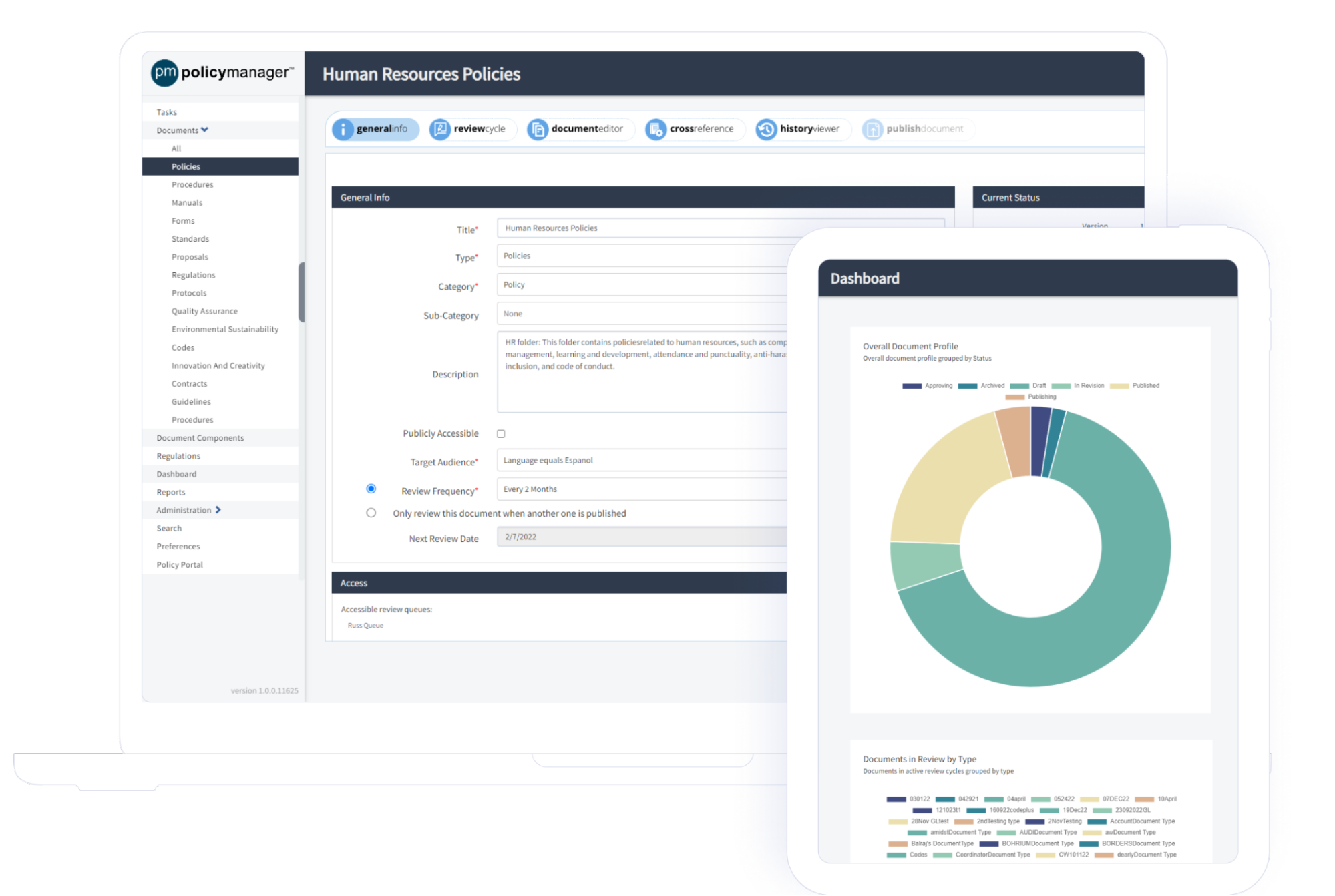
Version control maintains comprehensive audit trails showing how policies evolved over time, essential for demonstrating governance maturity during customer audits and investor due diligence.
Whether you're pursuing your first SOC 2 certification or managing multi-framework compliance across global operations, the objective is to build a compliance function that accelerates revenue rather than constraining it.
Ready to simplify multi-framework compliance? Request a demo to see how Diligent IT Compliance helps organizations achieve certification faster while reducing audit fatigue.
Individual security standards like SOC 2 or ISO 27001 define specific requirements organizations must meet for certification. A cloud controls framework is the operational layer that implements those requirements efficiently.
Rather than building separate controls for each standard, a framework designs unified controls that satisfy multiple standards simultaneously. This approach reduces redundant work while often strengthening overall security posture through consistent implementation.
A well-designed cloud controls framework can support virtually any certification relevant to cloud environments. Common frameworks include SOC 2 Type II, ISO 27001, NIST Cybersecurity Framework, NIST 800-53, FedRAMP, HIPAA, PCI DSS, GDPR and CCPA.
The framework maps controls to each standard's specific requirements, enabling organizations to collect evidence once and demonstrate compliance across multiple certifications.
Most SaaS companies should start with SOC 2 Type II, which has become the baseline expectation for enterprise sales. ISO 27001 often follows due to significant overlap and international recognition.
Additional certifications depend on target markets: HIPAA for healthcare customers, FedRAMP for federal government, PCI DSS for payment processing. Building the cloud controls framework during SOC 2 preparation positions organizations for efficient expansion to additional certifications as customer requirements evolve.
Discover how Diligent IT Compliance can help your organization build a unified controls framework. Schedule a demo today.