
In this article

Strategic risk assessment has become essential for organizations navigating an increasingly volatile business environment. Whether you're a chief risk officer (CRO) with strategic risk squarely in your remit, or a CFO, CEO, or general counsel taking broader responsibility for your organization's risk strategy, understanding how to identify, assess and mitigate strategic risks is fundamental to achieving business objectives.
The stakes have never been higher. According to the Q3 2025 Business Risk Index by Diligent Institute and Corporate Board Member, legal and compliance leaders rate business risk at 7.9 out of 10, a 36% increase since Q1.
Geopolitical conflicts, regulatory unpredictability and macroeconomic pressures are converging to create an environment where risks evolve faster than many organizations can respond.
Considering the above, this guide will help you understand and navigate strategic risk by covering:
Strategic risk is a category of risk that threatens an organization's ability to set and implement its chosen strategy. Unlike operational or financial risks that affect day-to-day activities, strategic risks impact the fundamental decisions that determine an organization's direction and long-term success.
Deloitte defines strategic risks as "those that either affect or are created by business strategy decisions." This definition captures an important nuance: Strategic risks can be external forces that disrupt your plans, or they can emerge from the strategic choices your organization makes.
Expansion into new markets creates growth opportunities alongside unfamiliar competitive and regulatory challenges.
A definition focused only on external factors creates dangerous blind spots. Quality failures stemming from poor governance, compliance breakdowns from inadequate risk processes and competitive losses from strategic missteps all represent strategic risks that originate within the organization.
Understanding the components of enterprise risk management helps organizations take a holistic view of both internal and external threats.
A strategic risk assessment is a systematic process for identifying, analyzing and prioritizing risks that could affect an organization's ability to achieve its strategic objectives. Unlike tactical risk assessments focused on specific projects or operations, strategic risk assessments take a holistic view of threats and opportunities across the entire enterprise.
The assessment process typically involves defining strategic objectives, identifying potential risk events, evaluating likelihood and impact, prioritizing risks based on severity and developing response strategies.
Effective strategic risk assessments connect risk management directly to business strategy, ensuring that leadership makes informed decisions with full awareness of potential consequences.
"There needs to be collaboration between risk and the business, vertically up and down, but then also horizontally across the organization," says Michael Rasmussen, CEO of GRC Report. "It is absolutely essential — collaboration across risk departments. The problem is there are silos. Risk and audit are interconnected and interdependent."
Organizations looking to formalize their assessment processes can benefit from an annual risk assessment template that provides structure while remaining adaptable to specific organizational needs.
Organizations that conduct regular strategic risk assessments gain significant advantages over those relying on ad hoc or reactive approaches.
Strategic risk assessments provide leadership with the context needed to make informed decisions. When boards and executives understand the risk implications of strategic choices, they can pursue opportunities with appropriate safeguards while avoiding blind spots that lead to costly surprises.
By identifying and prioritizing risks systematically, organizations can allocate resources where they matter most. Rather than spreading risk mitigation efforts thinly across all potential threats, strategic assessments enable focused investment in areas with the highest potential impact on objectives.
Investors, board members and regulators increasingly expect organizations to demonstrate sophisticated risk oversight. A documented strategic risk assessment process signals governance maturity and provides assurance that leadership is actively managing threats to long-term value.
For companies preparing for transactions or public offerings, this demonstrated capability directly impacts valuations.
Organizations with established assessment frameworks can identify and respond to emerging risks more quickly. The infrastructure for evaluating risks — including processes, metrics and reporting channels — enables rapid assessment when new threats materialize rather than scrambling to build capabilities during a crisis.
Strategic risk assessment isn't just about avoiding threats. It's about identifying opportunities. The same process that surfaces potential disruptions can reveal competitive advantages, market shifts and strategic openings that organizations positioned defensively would miss entirely.
Understanding specific types of strategic risk helps organizations build comprehensive monitoring and response capabilities. Many of these risks are interconnected — operational failures can trigger reputational damage, which amplifies financial risk.
This interdependence underscores the importance of taking an integrated approach to strategic risk management.
Competitive risk emerges when rivals innovate and improve their offerings faster than your organization. In rapidly evolving markets, yesterday's competitive advantage can become tomorrow's liability.
Digital-native competitors particularly threaten established players with legacy systems and traditional business models.
Every significant organizational change — digital transformation, restructuring, market expansion — introduces inherent risks. Change initiatives can disrupt operations, strain resources and create vulnerabilities during transition periods.
The challenge intensifies when multiple change programs run simultaneously without coordinated oversight.
New regulations can disrupt business models, create compliance obligations, demand technology investments and distract leadership from core operations. The regulatory landscape evolves continuously, with requirements varying significantly across jurisdictions.
Missing a regulatory development can result in penalties, operational restrictions or reputational damage.
Learn more about today's most pressing regulatory risks by downloading the latest edition of our global compliance outlook.

Reputational risk threatens your organization's standing with stakeholders, customers and the public. The causes are diverse: compliance breaches, executive misconduct, product failures, environmental incidents or poor ESG performance. In the age of social media, reputational damage can spread rapidly and prove difficult to contain.
Understanding who is responsible for reputation management helps organizations establish clear accountability for protecting their brand.
Political change — elections, policy shifts, international tensions — can disrupt business operations in ways that are difficult to predict and impossible to control. Supply chain exposure to politically volatile regions, regulatory shifts following elections and geopolitical conflicts all represent political risks that strategic planning must account for.
Poor governance creates cascading risks across an organization. Inadequate board oversight, weak internal controls, unclear accountability structures and insufficient risk management processes all fall under governance risk. These failures rarely stay contained — they enable and amplify other risk categories.
Every company's strategy includes an element of risk; the board plays a crucial role in working with the CEO to identify these risks, stress-test the strategy against them and ensure mitigation plans are in place.
Understanding the fiduciary duties of board members is essential for directors taking on this responsibility.
Financial risks relate to your organization's fiscal health: liquidity challenges, currency exposure, interest rate sensitivity, credit risk and capital structure vulnerabilities. While some financial risks originate externally, many stem from internal decisions about leverage, investment and treasury management.
Economic risk encompasses broader macroeconomic factors: recessions, inflation, interest rate changes, currency fluctuations and shifts in consumer spending. These forces affect entire markets and industries, making them difficult to avoid but possible to prepare for.
Operational risk arises when business processes, systems or people fail to perform as expected. Supply chain disruptions, technology failures, human error and inadequate controls all represent operational risks that can cascade into strategic consequences when they affect core business functions.
Amongst all these strategic risk examples, there are positives. The linkages that cause one risk to increase the chances of another can also work to your advantage. Take a coordinated, integrated stance on one aspect of strategic risk, and your performance in others should also improve.
As companies refine their risk-mitigation approaches, they become better able to recognize these connections. As a result, they can approach risk strategically, capitalizing on synergies for a more robust result.
Below we’ve set out some specific tips that can help you tackle the different strategic risk examples:
Remaining competitive requires understanding your competition at a granular level. Invest in competitive intelligence capabilities that provide your board with real-time market insights. Technology can be your ally in aggregating and analyzing competitive data, transforming information overload into actionable strategic guidance.
Put governance at the heart of change programs. Establish clear accountability, define success metrics and create feedback mechanisms that surface problems early. The organizations that manage change effectively treat governance as an enabler of transformation, not a bureaucratic obstacle.
Following corporate governance best practices during periods of change helps maintain stability while enabling innovation.
Staying ahead of regulatory change requires continuous monitoring and proactive preparation. Organizations can't meet expectations they're not aware of, making regulatory intelligence a strategic priority.
Automated monitoring tools that track regulatory developments across relevant jurisdictions help ensure nothing falls through the cracks.
Bolster your governance, risk and compliance (GRC) processes. Organizations with strong GRC foundations have better odds of avoiding the incidents that trigger reputational crises. When issues do arise, robust processes enable faster identification and response, limiting damage before it escalates.
While you cannot control political developments, you can build resilience into your operations. Diversify supply chains to reduce dependence on volatile regions. Monitor political developments in key markets and develop scenario plans for potential disruptions. Geographic diversification and operational flexibility provide buffers against political uncertainty.
Establish robust governance structures with clear roles, responsibilities and reporting lines. Ensure board committees have the information and expertise needed for effective oversight. Regular governance assessments help identify weaknesses before they become crises.
Strong board governance provides the foundation for managing all other risk categories effectively.
Improve your ability to measure, monitor and respond to financial risks through better data and analytics. Stress-test financial positions against various scenarios. Ensure treasury and finance functions have visibility into enterprise-wide exposures that could impact financial stability.
Build sustainable, diversified operations that can weather economic volatility. Monitor economic indicators and adjust strategic plans accordingly. Scenario planning for different economic conditions helps organizations respond quickly when circumstances change.
Introduce agility, rigor and structure to operations. Operational risk is one area where you have significant control: process improvements, technology investments and employee training all reduce exposure. Continuous monitoring and regular assessments help identify vulnerabilities before they cause disruptions.
Building an effective strategic risk assessment process requires a systematic methodology and sustained commitment. The following framework provides a foundation that organizations can adapt to their specific context and maturity level.
For organizations seeking structured guidance, an ERM strategy framework can provide additional direction.
Begin by clearly articulating your organization's strategic objectives and the level of risk acceptable in pursuing them. This foundation ensures that risk assessments remain connected to business priorities rather than becoming abstract exercises.
Document both what you're trying to achieve and how much risk you're willing to accept along the way.
"Keep it practical. Keep the ERM program practically designed and not overly complex through the entire lifecycle of the ERM process," advises Maurice L. Crescenzi, Jr., Industry Practice Leader at Moody's. "High, medium, low are good enough. Keep your presentations to the board simple."
Systematically identify circumstances that could threaten or create opportunities for your organization. Consider both internal factors (governance, operations, culture) and external forces (competitive, regulatory, economic, political).
Engage stakeholders across the organization, as different perspectives surface risks that siloed analysis would miss.
Evaluate each identified risk based on the probability of occurrence and potential impact if it materializes. Use consistent criteria across risks to enable meaningful comparison.
Consider both quantitative measures (financial impact, operational disruption) and qualitative factors (reputational damage, strategic setback) in your assessment. Organizations can use an ERM maturity model to benchmark their assessment capabilities against industry standards.
Not all risks warrant equal attention. Prioritize based on combined likelihood and impact assessments, focusing resources on risks that pose the greatest threat to strategic objectives. For each priority risk, develop response strategies: accept, avoid, mitigate or transfer. Assign clear ownership for executing response plans.
Implement ongoing monitoring that tracks both risk indicators and response effectiveness. Define key risk indicators (KRIs) that provide early warning of changing conditions. Establish reporting cadences that keep leadership informed without overwhelming them with data.
Board reporting should highlight significant changes and emerging concerns rather than comprehensive status updates.
"[Visuals are] very important," says Inna Barmash, Chief Legal Officer & Corporate Secretary at Amplify. "The first presentation was, 'Here are some risks.' We put up a heatmap, and I could feel the board's sigh of relief. A heatmap is a communication tool."
Strategic risk assessment requires regular review as internal processes and external conditions evolve. Schedule periodic reassessments and build in triggers for ad hoc reviews when significant changes occur. The risks that mattered most last year may not be the same risks that matter most today.
Traditional approaches to strategic risk management can't keep pace with how quickly risks evolve. By the time leadership reviews static risk reports, conditions may have already changed significantly.
AI-powered platforms are transforming this reality by enabling continuous monitoring, automated analysis and real-time visibility into strategic risk.
For organizations launching or advancing risk programs, Diligent's AI Risk Essentials provides a fast path to maturity. The platform uses AI-powered peer benchmarking against 180,000+ real-world risks from SEC 10-K filings to identify industry-specific threats automatically.
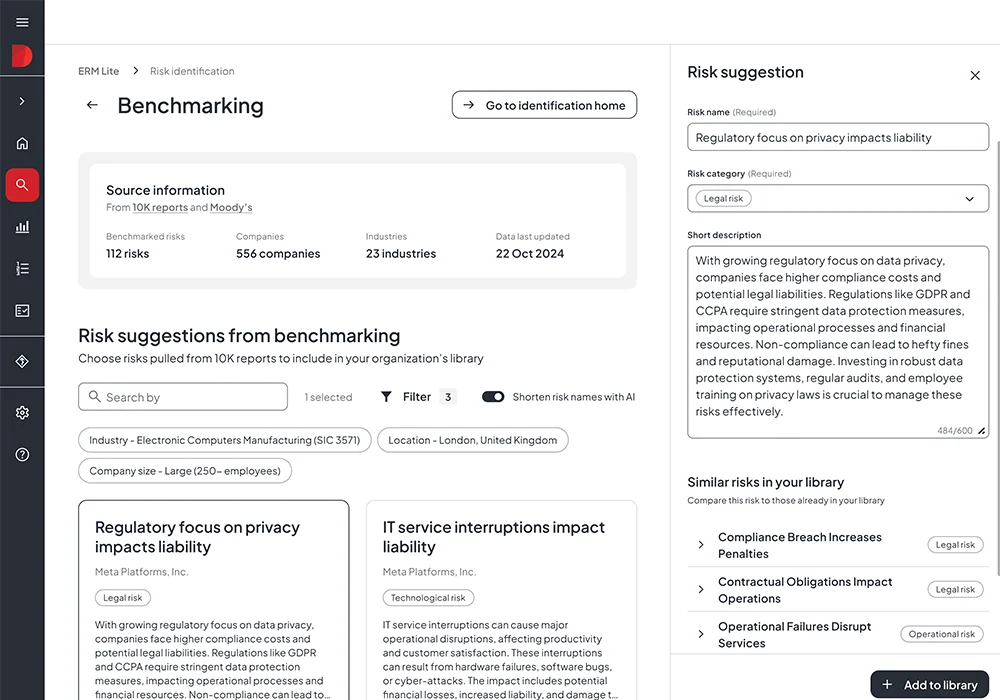
Implementation takes days rather than months, and the system provides the training tools and templates that lean teams need to launch effective programs without hiring consultants.
"It's a solution that was properly priced, quick to deploy and simple to learn — enhancing our enterprise risk management program and delivering immediate value to all stakeholders," says Melanie McGrath, General Counsel at CBCL Limited.
And for organizations with established programs seeking comprehensive capabilities, Diligent ERM provides enterprise-grade risk orchestration. The platform centralizes risk data across business units and geographies, automates assessments and reporting, and delivers AI-driven intelligence that helps teams identify emerging risks before they escalate.
Integration with Moody's benchmarking data adds external risk intelligence, while automated board reporting connects operational insights directly to governance oversight.
Whether you're launching your first strategic risk program or connecting existing capabilities across the enterprise, the goal remains the same: Building a risk management function that gives leadership the visibility they need to make confident decisions.
Ready to transform your strategic risk management capabilities? Request a demo to see how Diligent can help your organization build a comprehensive risk program.
Strategic risk threatens an organization's ability to achieve its long-term objectives and execute its chosen strategy. Operational risk, by contrast, relates to day-to-day processes, systems and procedures.
While operational failures can escalate into strategic consequences, strategic risks fundamentally concern the organization's direction and competitive position rather than its routine functions.
Most organizations benefit from annual comprehensive strategic risk assessments, with quarterly reviews to monitor changes in priority risks.
However, significant internal changes (mergers, leadership transitions, strategy shifts) or external developments (regulatory changes, market disruptions, economic shifts) should trigger ad hoc reassessments.
The key is maintaining continuous awareness rather than treating assessment as a periodic compliance exercise.
Ultimate accountability for strategic risk rests with the board and CEO, who set risk appetite and ensure appropriate oversight. Day-to-day management typically falls to the chief risk officer or equivalent role, with support from finance, legal and compliance functions.
However, effective strategic risk management requires engagement across the organization — business unit leaders own risks within their areas and provide the operational intelligence that informs enterprise-level assessments.
Schedule a demo to see how Diligent helps organizations identify, assess and mitigate strategic risks.