
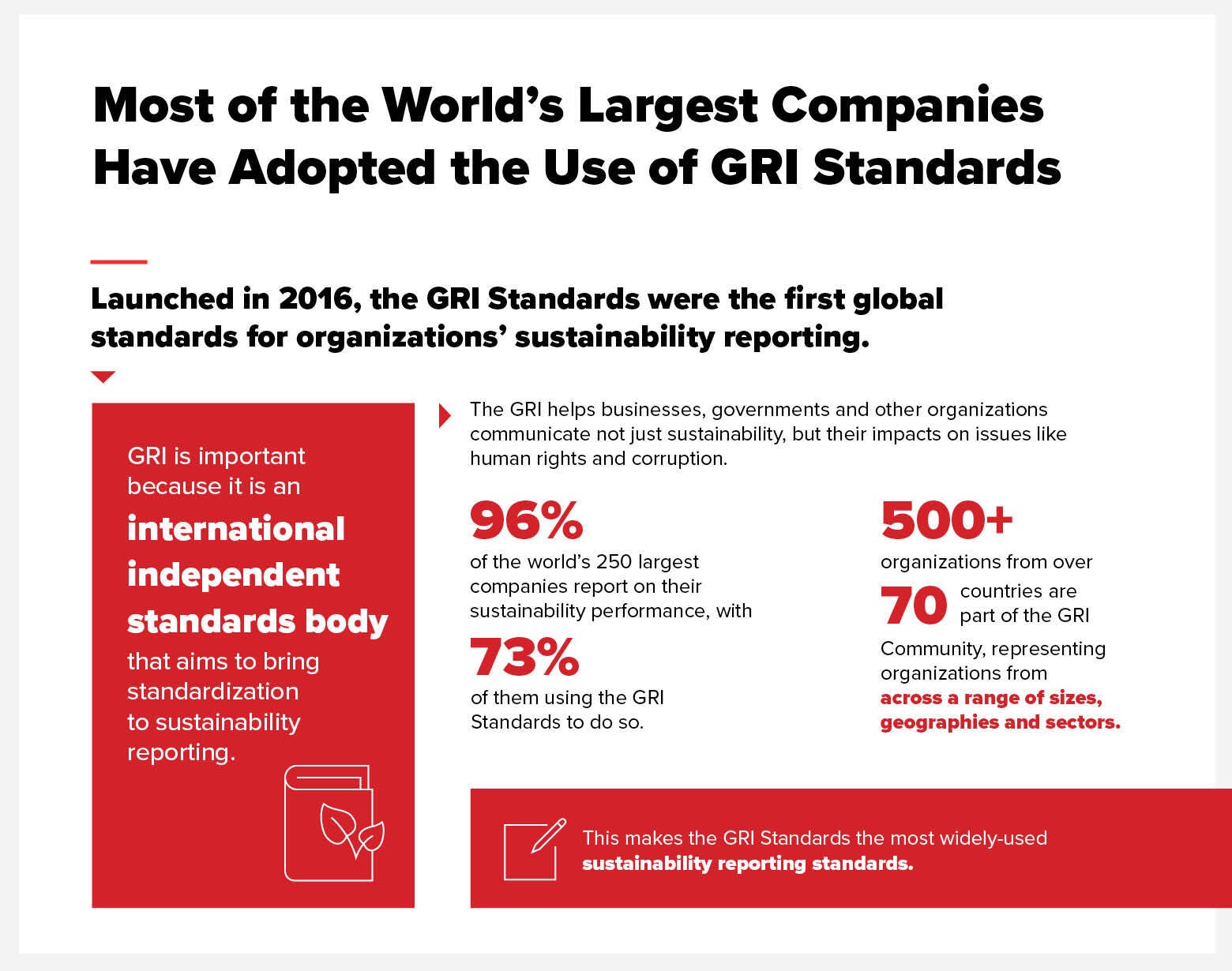
Launched in 2016, the GRI Standards were the first global standards for organizations’ sustainability reporting. The Standards aim to bring consistency and rigor to the sustainability reporting process, in response to trends towards greater sustainability and impact reporting.
They are the latest in a series of reporting frameworks built by the Global Reporting Initiative (GRI). Why is GRI important? — because it is an international independent standards body that aims to bring standardization to sustainability reporting.
The GRI helps businesses, governments and other organizations communicate not just sustainability, but their impacts on issues like human rights and corruption.
As transparency in business grows more highly prized, and climate disclosures become more commonplace, businesses look for benchmarks and frameworks to help them. Organizations needing to publish a sustainability report (sometimes termed a Corporate Social Responsibility (CSR) report or Environmental, Social and Governance (ESG) report) are looking for standardized ways to fulfill their obligations. The GRI Standards are one of the ways they’re attempting to do this.
ESG considerations are growing ever more central to business. The importance of ESG spans corporate size, geography and sector, as customers, investors, business partners and employees vote with their conscience and their wallets.
Organizations recognize that strong ESG performance can be good for business — but the potential for accusations of greenwashing means that ESG claims need to be evidenced. The challenges in capturing and reporting on ESG metrics are leading increasing numbers of businesses to seek defined standards and guidance on sustainability reporting. Universal standards can be hard to come by — making the GRI Standards a welcome aspect of the ESG reporting landscape.
In their 2020 Survey of Sustainability Reporting, KPMG found that 96% of the world’s 250 largest companies report on their sustainability performance, with 73% of them using the GRI Standards to do so.
In total, more than 500 organizations from over 70 countries are part of the GRI Community, representing organizations from across a range of sizes, geographies and sectors.
This makes the GRI Standards the most widely-used sustainability reporting standards globally.
The GRI Standards are issued by the Global Sustainability Standards Board (GSSB), an independent operating entity of GRI.
They are modular, comprising several sets of standards that can be adopted by companies of different sizes and sectors:
The GRI reporting standards are reviewed to ensure they continue to reflect global best practices on sustainability reporting, in line with evolving requirements and regulations.
The GRI framework and standards are comprehensive: you can see a full list on the GRI’s website.
The GRI Universal Standards help organizations to identify their material topics and introduce principles they should use when reporting.
The Sector Standards are organized into four Priority Groups:
The Topic Standards are split into three series: the 200 Series, which focuses on economic topics, the 300 Series, which explores environmental topics and the 400 Series, which focuses on social topics.
The full list of GRI Standards is as follows:
You might wonder: why is sustainability reporting using the GRI Standards important for you or your organization? And how do you use GRI Standards in your reporting?
There are many reasons why a company might use the GRI Standards as a framework for the preparation of its sustainability reports.
If you’re already using the GRI Standards as a framework for your sustainability reporting, you will know that they can bring consistency and confidence to your ESG metrics, positioning you well for any ESG due diligence your investors or customers may do.
If you’re yet to fully explore the potential of the Standards, hopefully, this GRI Standards summary has helped you to understand their structure and benefits.
Organizations reporting via the GRI Standards are required to comply with Reporting Principles that mandate using reliable and quality information. This is central, as the quality and availability of ESG data can be one of the obstacles for businesses trying to improve their ESG reporting.
Businesses can (but do not have to) use external assurance to enhance the credibility of their reporting. If an organization does seek external assurance, it must also include the assurance report with its GRI reporting.
Without external assurance, organizations need other checks and measures to ensure their reporting is valid and robust.
This can be a challenge; ESG is a vast and multi-faceted topic for businesses to get to grips with, and data can be a barrier. Diligent ESG can help you to access this data and give assurance that it is accurate. As a result, you can accelerate your progress, no matter where you are on your journey.
Diligent Modern ESG allows you to map ESG data against a range of standards, including GRI, helping you with reporting according to GRI standards and allowing you to track ESG progress against your peers and competitors.